

By Josh Kilen
Most family law marketing advice treats it like any other legal practice area. Run some Google Ads. Write a few blog posts. Collect reviews. Wait for the phone to ring.
That advice misses the single most important thing about family law clients: they are not shopping. They are in crisis.
Someone searching for a divorce attorney at 11:30 PM on a Wednesday just had the worst conversation of their life. Someone Googling “child custody lawyer near me” might be sitting in their car in a parking lot, trying to figure out what happens next. Someone typing “how to file for divorce” just crossed a line they’ve been thinking about for months or years.
Your marketing has to meet them there. Not with generic professional language. Not with stock photos of gavels. Not with a homepage that talks about your firm’s 30 years of combined experience. With messaging that says: I understand what you’re going through, and I can help you take the next step.
We built a family law marketing strategy for Torrone Law that generates 80+ appointments per month at a 10x return on ad spend. That result didn’t come from spending more than the competition. It came from understanding the emotional state of someone searching for a family law attorney and building every ad, every landing page, and every follow-up around that understanding.
This guide covers exactly how we did it and how the same approach applies to your firm.
Family Law Clients Are Not Comparison Shoppers
Before we talk about channels and tactics, you need to understand the buyer. Because family law clients behave differently from almost every other legal client.
Estate planning clients research for months. Corporate clients run RFPs. Personal injury clients get referrals.
Family law clients? They’re making one of the biggest decisions of their lives while angry, scared, heartbroken, or all three at once. The decision to search for a divorce lawyer often happens in a single moment. After a fight that went too far. After discovering infidelity. After being served papers.
This creates two realities that shape your entire marketing strategy:
First, the window of action is narrow. When someone decides they need a family law attorney, they want to talk to someone today. Not next week. Today. If your firm doesn’t show up at that exact moment, or if your intake process makes them wait, they’ll call the next firm on the list.
Second, trust is the primary buying factor. Family law clients need to tell a stranger about the worst parts of their marriage, their fears about losing custody of their children, their financial situation, and their deepest vulnerabilities. They need to trust you before they’ll even make the first call. Your marketing has to build that trust before the consultation ever happens.
Everything that follows in this article serves those two realities: be present at the moment of need, and build trust before the first conversation.
Google Ads: The Primary Channel for Family Law Firms
Google Search Ads are the backbone of family law marketing. Full stop. Not because they’re trendy. Because they capture people at the exact moment of highest intent.
When someone types “divorce lawyer near me” or “child custody attorney [city]” into Google, they are ready to hire. They’re not browsing. They’re not researching. They’ve already made the emotional decision that they need an attorney. They just need to find the right one.
Here’s what makes Google Ads work for family law (and what makes them fail):
What makes them work
Keyword targeting that matches real search behavior. The highest-converting keywords aren’t the broadest ones. “Family law attorney” has volume, but “divorce lawyer near me,” “child custody attorney [city],” and “what to do when served divorce papers” convert at higher rates because they signal a specific person at a specific stage of crisis.
Ad copy that speaks to the emotional state. Generic ad copy like “Experienced Family Law Attorneys. Call Today.” performs worse than copy that acknowledges what the searcher is feeling. Something like “Going Through a Divorce? Get Answers Today” or “Protect Your Custody Rights. Confidential Consultation” speaks directly to the fear and urgency driving the search.
Landing pages built for conversion, not information. This is where most firms lose. They send Google Ads traffic to their homepage or a generic practice area page that talks about the firm’s history. The person who just searched “divorce lawyer near me” doesn’t care about your founding story. They need to see three things in the first five seconds: you handle their specific situation, you can talk to them today, and other people in their situation trusted you and were glad they did.
What makes them fail
Sending traffic to the wrong page. I’ve audited firms spending $8,000+ per month on Google Ads that send every click to their homepage. Their homepage talks about six practice areas, has a stock photo of a handshake, and buries the phone number in the footer. That’s a money-burning problem.
No conversion tracking. If you can’t trace a click through to a phone call, a form fill, and eventually a signed client, you’re guessing at performance. We’ve seen firms celebrate “lots of clicks” while their cost per signed client was north of $5,000 because no one tracked the full funnel.
Bidding on keywords you can’t support. If you run ads for “child custody attorney” but don’t have a dedicated custody page, Google gives that click a low quality score, charges you more, and the visitor bounces because they landed somewhere that doesn’t match their search.
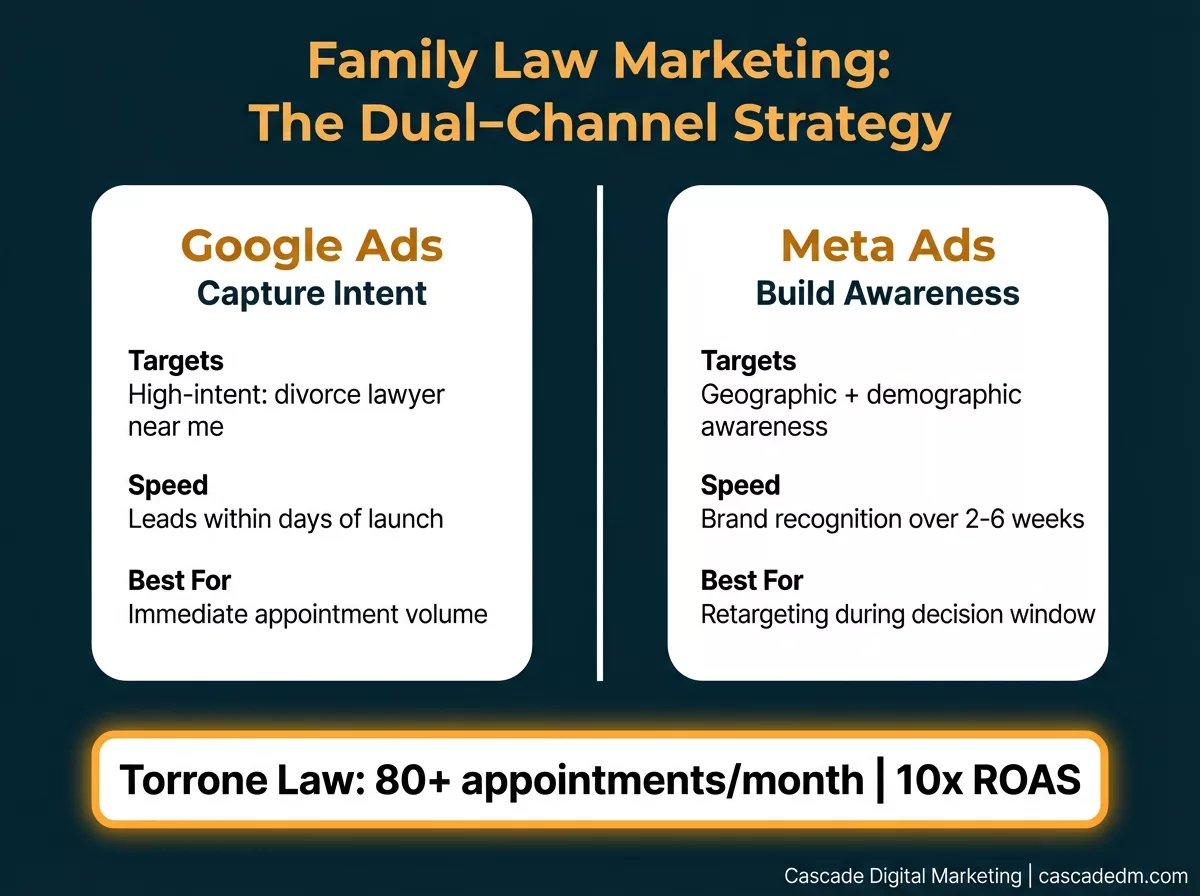
For Torrone Law, Google Ads accounts for the majority of their 80+ monthly appointments. The ads target high-intent keywords specific to their practice areas and geographic market. Every ad points to a dedicated landing page that matches the search intent. And every landing page is built around empathy first, credentials second, and a clear path to contact third.
Meta/Facebook Ads: The Awareness and Retargeting Engine
Here’s what most people get wrong about Facebook ads for family law firms: they try to use them like Google Ads. Nobody scrolling Facebook is looking for a lawyer. That’s not how the platform works.
Meta ads serve two purposes in family law marketing. Both are valuable. Neither is direct response.
Purpose 1: Awareness
The time between “I think I might need a divorce attorney” and “I’m hiring this attorney” can stretch from a few days to several weeks. During that time, the potential client is thinking, Googling, talking to friends, and mentally preparing for one of the hardest decisions of their life.
Meta awareness campaigns put your firm’s name in front of people in your geographic area before they ever search for a lawyer. When they do eventually search, your firm isn’t a stranger. That familiarity translates directly into higher click-through rates on your Google Ads and higher conversion rates on your website.
Purpose 2: Retargeting
This is where Meta becomes powerful. Someone visits your website from a Google search but doesn’t call. Maybe they weren’t ready. Maybe they got interrupted.
Retargeting shows that person your ads on Facebook and Instagram over the following days and weeks. The messaging can be different because you know they’ve already expressed interest. Retargeting ads can feature client testimonials, your attorney’s approachability, or a reminder that a confidential consultation is available.
For Torrone Law, the combination of Google Ads for intent capture and Meta campaigns for awareness and retargeting is what produces the 10x ROAS. Neither channel alone would achieve the same result. Google captures the person at the moment of need. Meta builds the familiarity before that moment and stays present after the first visit.
Reviews and Testimonials: The Trust Engine You Can’t Fake
In most industries, reviews are a nice-to-have. In family law, they are a near-requirement.
Think about what you’re asking a potential client to do. Call a stranger. Sit in an office. Share the most personal, painful details of their life. Before they make that call, they need proof that other people in the same situation called you and were glad they did. That’s what reviews provide. Not a star rating. Proof.
What makes a family law review effective
The reviews that convert aren’t the ones that say “Great attorney, highly recommend.” They’re the ones that say something like: “I was terrified when my ex filed for custody. I didn’t know what to do. [Attorney name] walked me through everything and made me feel like I wasn’t alone. I got the outcome I needed for my kids.”
That review works because it mirrors the emotional state of the person reading it. They’re terrified too. They don’t know what to do either. And they just read that someone in their exact situation found help at your firm.
How to build your review pipeline
Ask every satisfied client. Not once. At the right moment, usually after a positive outcome or milestone in their case. Most people won’t leave a review unprompted, but they will if you ask and make it easy.
Make the process simple. Send a direct link to your Google Business Profile review page. Don’t ask them to find you on Google and figure out where to click. Every extra step loses people.
Respond to every review. Good and bad. Responding to positive reviews shows you care. Responding to negative reviews (carefully, without violating confidentiality) shows potential clients that you take concerns seriously.
A compliance note on testimonials: Most state bars allow client reviews on third-party platforms but require disclaimers when you use testimonials in your own marketing materials. If you pull a client quote for your website or an ad, include a disclaimer that past results don’t guarantee future outcomes. Check your state bar’s specific rules because the requirements vary.
Your Website: The First Consultation Before the Consultation
Your website is where trust is built or broken. For family law, it has to do three things simultaneously: feel empathetic, look professional, and make contact effortless.
Get the tone right. The biggest mistake I see is a tone that’s either too corporate or too aggressive. “Our aggressive litigation team will fight for your rights” reads as combative to someone who’s already emotionally drained. The right tone acknowledges the difficulty of the situation and offers clarity: “If you’re facing a divorce, custody dispute, or family legal matter, you deserve an attorney who listens first and fights when it matters.”
Build dedicated practice area pages. Every major service needs its own page: divorce, child custody, child support, spousal support, property division, prenuptial agreements. Each page should target the specific keywords someone would use to find that service and answer the questions a person in that situation actually has. These pages serve a psychological function, too. When someone finds a page dedicated to their exact issue, it signals that your firm handles this regularly.
Use real photos and bios. Stock photos of courthouses and scales of justice are meaningless. Family law clients are choosing a person, not a firm. A real photo with an approachable expression and a bio that includes something human alongside the credentials builds connection before the first call.
Make contact feel safe. “Schedule a Confidential Consultation” converts better than “Contact Us” because it addresses the unspoken fear: will this be private? Offer multiple contact methods (phone, form, live chat, text). Some clients aren’t ready to call. A form feels safer. Meet people where they are.
The Compliance Angle: Bar Rules Shape Your Marketing
I mention this in every piece of legal marketing content I write because it matters and because most marketing agencies ignore it entirely.
State bar advertising rules govern what you can say in your marketing. For family law specifically, common restrictions include:
- No outcome guarantees. You cannot promise specific results in custody, support, or property division. “We’ll get you full custody” is a bar complaint waiting to happen.
- Testimonial disclaimers. If you use client testimonials in ads or on your website (not just third-party review sites), most states require a disclaimer that past results don’t guarantee future outcomes.
- Specialization claims. Many states prohibit calling yourself a “specialist” in family law unless you have a board certification. Use “focused on” or “dedicated to” instead.
- “Free consultation” disclosures. If you offer a free initial consultation, some states require you to disclose whether any conditions apply or what the consultation covers.
This isn’t just a legal risk. It’s a trust issue. Potential clients who see overblown promises (“We guarantee the best outcome for your case”) know, even subconsciously, that something feels off. Accurate, honest messaging converts better than hype because your audience is smart enough to know the difference.
If your marketing agency hasn’t reviewed your state bar’s advertising rules before writing your first ad, find one that will. This is not optional in legal marketing. We review bar rules for every law firm client before a single campaign launches.
Content Marketing: The Supporting Actor, Not the Lead
Here’s an honest take: content marketing is not the primary growth driver for family law firms. That role belongs to digital advertising and paid search. The decision cycle is too short and too emotional for most clients to read six blog posts before hiring an attorney.
But content plays a critical supporting role in three ways.
Reducing anxiety. Someone who just got served divorce papers has a hundred questions. What happens next? How long does this take? Will I lose my house? If your website has clear answers, it builds trust and lowers the barrier to contact. The best-performing family law content isn’t SEO filler. It’s genuine answers to questions people are too afraid to ask in person: “What to expect when filing for divorce in [state],” “How child custody is determined,” “What happens to the house in a divorce.”
Building organic traffic. A content marketing program builds a traffic channel that compounds over 12-18 months. That traffic is free, it’s ongoing, and every organic visitor feeds your Meta retargeting audiences.
Supporting ad campaigns. Content gives your retargeting something to point to beyond “call us.” A retargeting ad that says “Not sure what to expect in a custody case? Here’s what you need to know” and links to a helpful article builds more trust than another ad asking them to call.
SEO Strategy: Two Keyword Categories That Matter
SEO for family law firms breaks into two categories, and you need both.
Location + service keywords are the bread and butter: “divorce lawyer [city],” “child custody attorney [city],” “family law firm [city].” These have commercial intent and map directly to your practice area pages. Your website needs a dedicated, optimized page for each combination of service and location you serve. These are also the keywords your Google Ads target. When paid and organic listings both appear for the same search, your combined click-through rate goes up.
Emotional and question keywords are the searches people make in the early stages of crisis: “how to file for divorce in [state],” “what to do when served divorce papers,” “how is child custody determined.” These are informational, not commercial. The searcher isn’t looking for a lawyer yet. They’re looking for answers. But the person asking “what to do when served divorce papers” today is going to search for “divorce lawyer near me” within a week or two. If your firm provided the answer to their first question, you’re not a stranger when they’re ready to hire.
A good marketing strategy targets both categories. Practice area pages for commercial keywords. Blog content for emotional and informational keywords. Together, they capture people at every stage of the decision process.
The Honest Section: What Breaks Family Law Marketing
I told you earlier that family law marketing works fast when it’s done right. That’s true. Unlike estate planning, where you’re building organic traffic over 18 months, family law campaigns can generate consultations within the first two weeks of launching Google Ads. The intent is high, the decision cycle is short, and the search volume is substantial.
But here’s what nobody talks about: the number one reason family law marketing fails has nothing to do with marketing.
It’s the intake process.
If someone clicks your ad at 9 PM, fills out your contact form, and doesn’t hear back until 2 PM the next day, you’ve lost them. They already called three other firms. One of them picked up on the second ring, was warm and reassuring, and scheduled a consultation for the next morning. That firm signed the client. You paid for the click.
Speed-to-lead matters more in family law than almost any other practice area. Firms that respond to leads within 5 minutes convert at dramatically higher rates than firms that respond within an hour.
Here’s what that means practically:
- Answer the phone. If you can’t answer every call during business hours, get an answering service. Not voicemail. Not an auto-reply email. A person.
- Respond to form submissions fast. Every form fill should trigger a callback within five minutes. An auto-responder is a stopgap, not a solution.
- Offer after-hours options. Family law crises don’t happen 9-to-5. A live chat widget, text option, or after-hours answering service captures leads that would otherwise go to the competitor who’s available at 10 PM.
- Train your intake staff. The person answering the phone is your firm’s first impression. If they’re cold or rushed, no amount of ad spend can overcome that.
I’ve watched firms spend $5,000 a month on ads that generate 60+ leads, only to sign 4 clients because their intake process leaked like a sieve. The marketing worked. The operations didn’t.
If you’re not sure whether your intake is the problem, do this: have someone call your firm at 4:45 PM on a Friday and pretend to be a potential client. See what happens. That experience is the experience your real leads are having.
Frequently Asked Questions
How much should a family law firm spend on marketing?
Most family law firms generating consistent results spend between $3,000 and $8,000 per month, including ad spend, strategy, and campaign management. The critical thing isn’t the total budget but how it’s allocated. A firm spending $4,000 per month focused on Google Ads and Meta retargeting will outperform a firm spending $7,000 split across six channels. Start with what you can sustain for 12 months and put the majority behind paid search.
How long does it take for family law marketing to generate results?
This is one of the few practice areas where you can see results fast. Google Ads campaigns targeting high-intent family law keywords can generate consultations within the first one to two weeks. Building a full system that produces consistent, predictable lead flow at a sustainable cost per acquisition typically takes three to six months of optimization. SEO and content marketing, if included, take longer to mature (6-12 months) but reduce your reliance on paid ads over time.
Do family law firms need social media marketing?
Not in the way most agencies sell it. Regular organic posting (inspirational quotes, firm news, holiday messages) doesn’t drive family law clients to your door. But Meta/Facebook ads for awareness and retargeting are a proven supporting channel. And a professional social media presence builds credibility when potential clients check you out. Think of social media as a trust signal, not a lead generation channel. Don’t pay $1,500 a month to post to your Facebook page three times a week. Do invest in strategic paid campaigns on Meta that support your Google Ads efforts.
What’s the most common family law marketing mistake?
Spending money on marketing without fixing the intake process first. A firm invests in Google Ads, leads come in, but they don’t respond fast enough. The leads go to the competitor who picks up the phone. The firm concludes “marketing doesn’t work” and stops spending. The marketing worked. The follow-through didn’t. Fix intake before you scale marketing.
Get a Marketing Strategy Built for Family Law
Family law marketing is not generic legal marketing with a different keyword set. The emotional intensity of the client, the speed of the decision cycle, the role of trust and reviews, the compliance requirements, and the critical importance of intake speed all make it a category of its own.
The firms generating 80+ appointments per month aren’t spending the most. They’re spending on the right channels with messaging that meets clients in their most difficult moments, landing pages that convert trust into action, and intake processes that close the loop before the next firm on the list gets a chance.
If your firm is ready for a marketing strategy built specifically for family law, built on research, measured by appointments and signed clients, not clicks and impressions, let’s talk. We’ll start with your market, your competition, and your intake process, and build a plan designed to fill your calendar with the right clients.


