

By Josh Kilen
Personal injury lawyer advertising is the most expensive, most competitive, and most unforgiving advertising vertical in all of legal marketing. It’s not close. A single Google click for “car accident lawyer near me” can cost $200 or more in a major metro. Billboards in good locations run $10,000 to $30,000 per month. TV spots during local news cost thousands per airing. And the firms at the top of every market are spending six figures a month to stay there.
But here’s what makes PI advertising different from every other practice area: the math can justify those numbers. A single case can settle for $50,000 to $500,000+ on contingency. At a 33% fee, one signed case worth $300,000 generates $100,000 in revenue. Even expensive channels produce strong returns, if the system behind them converts.
That “if” is doing a lot of heavy lifting. Most PI firms spending serious money on advertising are leaking value at every stage: overpaying for clicks that go to bad landing pages, losing leads to slow intake, burning cash on channels that build ego instead of pipeline.
I’ve built marketing strategies for law firms across practice areas. The fundamentals are the same: research first, match the channel to the buyer, fix intake before scaling spend, and measure everything against signed cases. This guide covers what that looks like for PI firms.
The Economics of Personal Injury Advertising
Before we talk about channels and tactics, you need to understand the math that drives every decision in PI advertising. This is the foundation that separates firms that grow from firms that go broke.
Case Value Justifies the Spend
Personal injury operates on contingency. Your firm doesn’t get paid until the client does. Revenue per case is high enough to absorb expensive cost-per-lead numbers, but every dollar spent on advertising is a bet that won’t pay off for months or years depending on case duration.
Here’s a simplified version of the math:
- Average case value (settlement): $150,000
- Contingency fee (33%): $49,500 revenue per signed case
- Cost per click on Google Ads: $150
- Landing page conversion rate: 10% (1 in 10 clicks becomes a lead)
- Cost per lead: $1,500
- Intake conversion rate: 30% (1 in 3.3 leads becomes a signed client)
- Cost per signed case: $5,000
At $5,000 per signed case generating $49,500 in revenue, that’s roughly a 10x return. Excellent. But change any single variable and the picture shifts dramatically.
If your landing page converts at 5% instead of 10%, your cost per lead doubles to $3,000 and your cost per signed case jumps to $10,000. If your intake only converts 15% of leads, your cost per signed case hits $20,000. Still profitable at $49,500 per case, but far less so. And if your average case value is $75,000 instead of $150,000, those thin margins start to hurt.
This is why PI advertising requires discipline across the entire system, not just the ads. The advertising gets you leads. Everything downstream determines whether those leads become revenue.
The Metrics That Actually Matter
Stop tracking impressions and clicks. In PI advertising, the numbers that matter are: cost per qualified lead, intake conversion rate, cost per signed case, revenue per case, and return on ad spend.
Every PI firm I’ve talked to can tell me their monthly ad spend. Almost none can tell me their cost per signed case with accuracy. If you can’t connect advertising spend to signed cases, you’re flying blind in the most expensive ad market in legal.
Google Ads: The $200-Per-Click Reality
Google Search Ads are the primary digital advertising channel for PI firms. When someone searches “car accident lawyer near me,” they need a lawyer now. That intent is why clicks cost $200+ and why the channel still works despite the price.
Bidding Strategy
In competitive PI markets (Los Angeles, Houston, Chicago, Miami, New York), cost per click for top keywords runs $150 to $300+. In smaller metros, $75 to $150. Either way, you can’t experiment at $1,000 per month and expect meaningful data.
The minimum viable budget for PI search ads in a competitive market is $5,000 to $10,000 per month. In a top-ten metro, $15,000 to $25,000 per month. Below those thresholds, you won’t generate enough clicks for statistically meaningful conversion data, and you’ll be outbid during peak hours when accident victims research attorneys.
Landing Pages Make or Break the Math
Here’s where most PI firms fail. They spend $15,000 per month on Google Ads and send traffic to their homepage or a generic practice area page with a stock photo and a buried contact form.
A dedicated PI landing page should convert at 10% or higher. Getting there requires:
- A headline that matches the search query. If someone searched “truck accident lawyer in Dallas,” the landing page headline should say “Dallas Truck Accident Lawyer” or close to it. Not “We Handle All Types of Personal Injury Cases.”
- A prominent phone number. Above the fold. Click-to-call on mobile. PI leads often want to talk to a human immediately.
- Social proof. Case results (with required disclaimers), client testimonials, review counts, awards. The visitor is choosing between you and five other firms they clicked on. Give them a reason to stop searching.
- A short, clear form. Name, phone, brief description of the accident. Every extra field reduces conversions.
- Mobile-first design. Over 60% of PI searches happen on mobile. If your landing page isn’t fast and clean on a phone, you’re paying $200 per click for bounces.
Keywords and Match Types
The high-value PI keywords fall into a few categories:
Accident-type keywords: “car accident lawyer,” “truck accident attorney,” “motorcycle accident lawyer,” “slip and fall attorney.” These are high intent and high cost. Bid on the accident types your firm actually handles well.
Location-modified keywords: “[city] personal injury attorney,” “personal injury lawyer near me.” These capture local intent and tend to convert at higher rates than broad match terms.
Symptom/situation keywords: “what to do after a car accident,” “how long to file injury claim.” Lower intent, lower cost, lower conversion. These work as part of a content strategy but shouldn’t be the focus of paid search budget.
The mistake I see most often: firms bidding on every PI keyword without negative keyword management. You end up paying $150 for clicks from people searching “personal injury lawyer salary.” Tight keyword lists and aggressive negatives protect your budget from waste.
Local Service Ads: The Best Value in PI Advertising Right Now
If I had to pick one channel for a PI firm just starting to advertise, it would be Google’s Local Service Ads (LSAs). The “Google Screened” badge that comes with LSAs is becoming one of the most powerful trust signals in personal injury marketing.
Why LSAs Work for PI
LSAs appear above traditional search ads at the very top of Google results. They show your firm’s name, reviews, phone number, and the Google Screened badge. You only pay if Google counts it as a valid lead. No click charges, no impression costs.
- Cost per lead typically runs $100 to $250 for PI, compared to $1,000 to $3,000+ per lead from traditional search ads in competitive markets.
- Lead quality tends to be high because the user is calling directly from the ad. They’ve seen your reviews, your badge, and your specialty listed.
- Budget flexibility is greater. You can start at $2,000 to $3,000 per month and get real leads while you test and scale.
Getting and Keeping the Google Screened Badge
The badge requires background checks on your attorneys and ongoing review quality:
- Application. Google verifies bar admissions, runs background checks, and reviews insurance documentation.
- Review quality. Firms with fewer than 10 reviews or averages below 4.0 stars struggle to get leads. LSAs heavily weight review volume and recency.
- Responsiveness. Google tracks how fast you respond. Miss calls or respond slowly and you get penalized in lead distribution.
The catch: LSAs are getting more competitive. In some markets, lead costs have increased 30-40% year over year. Get in now while the economics still favor early adopters.
SEO for Personal Injury: A Long Game Worth Playing
Search engine optimization for personal injury is brutally competitive. The firms ranking on page one for “personal injury lawyer [major city]” have been investing in content and link building for years. You will not rank for those head terms in six months. But a smart SEO strategy built around specific accident types, locations, and educational content can produce significant organic traffic within 12 to 18 months.
Content Strategy for PI SEO
A PI content and SEO strategy should cover three tiers:
Tier 1: Practice area pages. Dedicated pages for each accident type: car, truck, motorcycle, pedestrian, slip and fall, medical malpractice, wrongful death. Each page needs 1,500+ words, local information, and specific keyword targeting.
Tier 2: Location pages. “Car Accident Lawyer in [City]” pages with local court information, traffic statistics, and neighborhood references. These capture location-modified searches and build local relevance.
Tier 3: Educational content. Blog posts answering real questions: “What to do after a car accident in [State],” “How long do I have to file a personal injury claim,” “Should I talk to insurance adjusters.” This captures top-of-funnel traffic and builds topical authority.
Link Building
Organic rankings for competitive PI terms require backlinks. The firms on page one have hundreds or thousands of referring domains. Building links through legal directories, local business associations, sponsorships, and earned media takes time. One shortcut that doesn’t work: buying links from private blog networks. Google is particularly aggressive at detecting link manipulation in legal verticals, and a manual penalty can cost millions in lost organic traffic.
TV and Billboards: Not Dead, But Not Where You Start
Mass media still plays a role in personal injury marketing. The biggest PI firms in every market spend heavily on television, billboards, and radio. But the role is specific, and most small-to-midsize firms misunderstand what mass media actually does.
What Mass Media Does Well
TV and billboards build brand recall. When someone gets in a car accident and thinks “I need a lawyer,” the name that comes to mind is the one they’ve seen on a billboard every day for six months or heard in a TV commercial 200 times. Accident victims often call the first firm that comes to mind in the first 24 to 48 hours after an incident.
The big PI firms spending $50,000 to $100,000+ per month on mass media aren’t tracking direct response. They’re building name recognition that makes every other channel more effective. When someone sees your Google Ad after months of billboard exposure, click-through rates go up. When they visit your website after hearing your radio spot, conversion rates climb.
Why Most Firms Shouldn’t Start Here
Mass media only works at scale. A single billboard for one month is forgettable. A TV spot airing twice a day for three weeks doesn’t build recall. The requirements:
- $20,000 to $50,000+ per month as a bare minimum for meaningful frequency
- 6+ months of consistent presence before brand recall takes hold
- Multiple placements (billboards in several locations, TV spots across multiple programs)
If you’re spending less than $20,000 per month on mass media, you’re almost certainly better off putting that budget into Google Ads, LSAs, or SEO where the ROI is directly measurable. Mass media is a scaling tool for firms that already have their digital channels producing results, not a starting point.
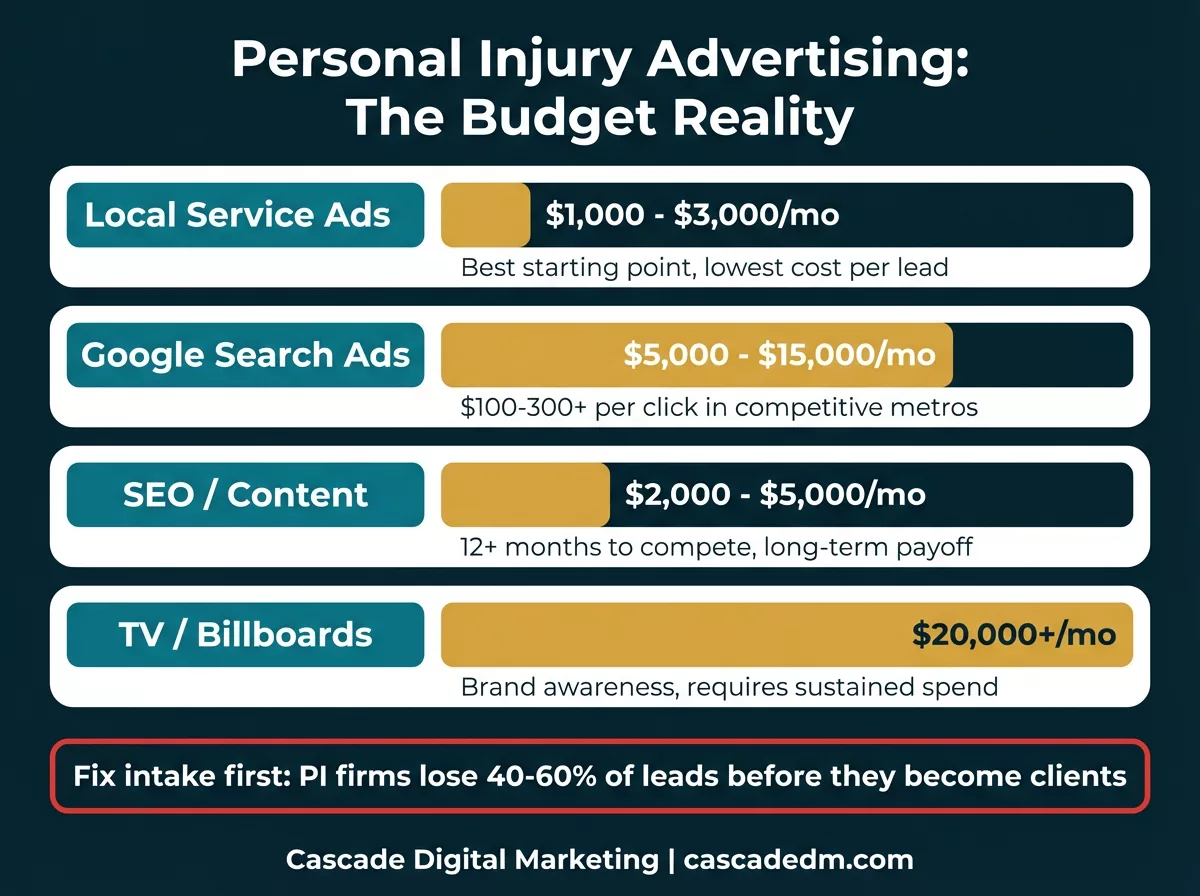
The Intake Problem: Where PI Firms Lose 40-60% of Their Investment
Here’s the part nobody wants to talk about: your intake process is probably losing you more money than bad ads ever could. PI firms lose 40 to 60% of potential clients during intake. The leads come in. And then the system breaks.
Common Intake Failures
Slow callback times. A PI lead not contacted within 5 minutes is dramatically less likely to sign. After 30 minutes, the probability drops by more than half. After an hour, they’ve called another firm. Most PI firms have callback times measured in hours, not minutes.
Poor phone handling. The person answering needs to be warm, empathetic, and trained to move callers toward a consultation. If your receptionist puts people on hold or sounds disinterested, you’re paying $200 per click to generate a lead and fumbling it at the 1-yard line.
No evening or weekend coverage. Accidents don’t happen during business hours. If someone calls at 7 PM on a Saturday and gets voicemail, they’re calling the next firm. A 24/7 answering service costs a fraction of your ad spend and captures leads you’re currently losing.
Case screening confusion. Your intake team needs clear criteria for which cases you accept and which you refer out. When staff are unsure, leads sit in limbo while the potential client moves on.
Fixing Intake Before Scaling Ads
Before you increase your ad budget by a single dollar, audit your intake. Call your own firm from a blocked number at different times. Submit a form and time the response. Listen to recorded calls.
If you fix intake from a 20% conversion rate to 35%, you’ve nearly doubled signed cases without spending another cent on advertising. That’s the highest-ROI investment in your entire marketing system.
Website Requirements for PI Firms
Your website is the hub of your entire advertising operation. Every ad, every search result, every referral sends someone to your site. If the site doesn’t convert, nothing else matters.
Non-Negotiables
Speed. Under 3 seconds load time on mobile. PI prospects are searching from phones in stressful situations. Slow site, lost lead.
Mobile-first design. Over 60% of PI searches happen on smartphones. Design for mobile first, desktop second.
Prominent phone number. Click-to-call in the header, sticky on mobile. Impossible to miss.
Live chat. Captures an additional 10-20% of leads from visitors who don’t want to call.
Practice area pages. Dedicated pages for each accident type: car, truck, motorcycle, pedestrian, bicycle, slip and fall, medical malpractice, wrongful death, dog bite, construction accident. Each page is a landing opportunity from organic and paid search.
Case results with disclaimers. Specific settlement and verdict amounts build credibility. Include required disclaimers (“Prior results do not guarantee a similar outcome” or your state’s language). Potential clients want to see you’ve handled cases like theirs.
Video testimonials. A real person describing how your firm helped them after an accident resonates far more than text. These are your highest-trust content assets.
Clear calls to action. Every page should make it easy to start a free consultation. Above the fold, mid-page, and at the bottom.
What I’d Tell You If You Hired Us Tomorrow (The Honest Part)
Most articles about personal injury attorney advertising make it sound like any firm can compete in PI with enough hustle and the right Google Ads account. That’s not true, and I’d rather lose you as a reader than waste your money with false expectations.
PI advertising is not for firms without budget. If you can’t commit $5,000 to $15,000 per month in ad spend alone (not counting agency fees or website work) for a minimum of six months, you will get outbid on every keyword and outspent on every channel. That’s not a motivation problem. It’s a math problem.
If you’re a solo PI attorney just starting out, don’t start with Google Ads. Start with referral networks: family law attorneys, criminal defense lawyers, chiropractors, auto body shops who see accident victims regularly. Get listed in directories. Apply for LSAs. Focus on reviews. These low-cost channels build the foundation you need before paid search makes financial sense.
Your first year will not be profitable. Even with a solid strategy, the first 6 to 12 months involve building data, testing landing pages, training intake, and optimizing campaigns. The firms that win treat year one as an investment, not a profit center. If you need positive ROI from month one, PI advertising isn’t the right move yet.
The firms dominating PI advertising in your market have a 3-to-5-year head start. Their landing pages have been tested across thousands of clicks. Their intake teams have handled tens of thousands of calls. Their SEO has been compounding for years. You can close that gap, but not in 90 days. Anyone telling you otherwise is selling something.
I’d rather tell you this now than take your money and hope you don’t notice the math doesn’t work at your budget level. When you’re ready to invest at the level PI requires, the returns can be extraordinary. But “ready” means capitalized, patient, and willing to fix operations alongside advertising.
Building a PI Advertising System: The Right Order
If I were building a personal injury law firm marketing system from scratch, here’s the sequence:
Months 1-2 (Foundation): Fix your website for speed and mobile. Audit intake (speed-to-lead, phone scripts, case screening, after-hours coverage). Set up conversion tracking so every lead traces back to its source. Optimize your Google Business Profile and start generating reviews.
Months 3-4 (First Channels): Launch Local Service Ads. Launch Google Search Ads at $5,000-$10,000/month focused on your highest-value accident types. Build dedicated landing pages. Start publishing educational content (2-4 posts/month) targeting long-tail PI keywords.
Months 5-8 (Optimization): Analyze cost per signed case by channel and keyword. A/B test landing pages. Expand keyword coverage based on what’s converting. Build backlinks. Add retargeting campaigns to re-engage visitors who didn’t convert.
Months 9-12+ (Scaling): Increase budget on campaigns with proven numbers. Expand into Meta for awareness and retargeting. Evaluate mass media based on your market. Organic traffic starts contributing meaningful leads. Refine case selection to focus on the most profitable case types.
Frequently Asked Questions
How much should a personal injury law firm spend on advertising?
There’s no single number, but there are minimums. Google Ads: $5,000 to $15,000/month. LSAs: $2,000 to $5,000/month. SEO and content: $3,000 to $6,000/month. Total, a mid-size PI firm in a competitive market should expect $10,000 to $25,000 per month across channels. In less competitive markets you can start lower, but $5,000 per month in total marketing spend is the realistic floor for any PI firm serious about growth.
How long does it take for PI advertising to generate signed cases?
Google Ads and LSAs can produce leads within two weeks, but a lead isn’t a signed case. Most firms see their first advertising-generated signed cases within 30 to 60 days of launching paid campaigns. Building a reliable system that produces consistent results takes 6 to 12 months of testing and scaling.
Should a PI firm hire a marketing agency or manage advertising in-house?
For most PI firms, an agency with specific legal advertising experience is the better choice. Managing Google Ads at $15,000+/month, maintaining LSA compliance, building SEO content, and tracking attribution requires specialized knowledge a paralegal handling marketing on the side can’t match. The key qualifier: “legal advertising experience.” A generalist agency won’t understand bar advertising rules, compliance around case result claims, or contingency fee economics. Ask any agency how many PI firms they manage and what cost-per-signed-case numbers they’ve achieved.
Are billboards and TV ads still worth it for personal injury lawyers?
Yes, but only at scale. They require $20,000 to $50,000+ per month in sustained spend. For firms already generating strong returns from digital channels and looking to build market dominance, mass media is a powerful scaling tool. For firms still establishing their digital foundation, that budget produces far better returns in paid search and content marketing.
Stop Guessing. Start Building the System.
Personal injury lawyer advertising rewards firms that treat it as a system. The firms booking the most cases connect every piece: ads that match search intent, landing pages that convert, intake teams that respond in minutes, and case selection that focuses on profitable work.
A $200 click that hits a slow landing page, reaches a voicemail at intake, and sits unreviewed for 48 hours isn’t an advertising problem. It’s a systems problem. Fix the system and the math works.
If you’re ready to build a PI advertising system based on real data and realistic budgets, let’s talk. We’ll start with your market, your numbers, and your current operations to build a plan that matches where you are today with where you want to be in 12 months.


