

By Josh Kilen
Someone just got arrested. It’s 2:17 AM on a Wednesday. They’re sitting in a holding cell with a phone, a bond amount they can’t process, and one thought: I need a lawyer. Right now.
They’re not browsing. They’re not comparing five firms. They’re not reading your blog post about “understanding your rights after an arrest.” They are typing “criminal defense lawyer near me” on a cracked phone screen with shaking hands, and they’re calling the first firm that looks like it can help them tonight.
That’s the client you’re marketing to. And if your marketing strategy wasn’t built for that moment, you’re losing cases to firms that aren’t better than you. They’re just faster.
Criminal defense marketing is a different discipline from every other area of legal marketing. The urgency is extreme, the decision window is measured in hours, and the channels that work for estate planning or family law will waste your money here. I’ve seen it happen. Firms spending $4,000 a month on social media and blog content while the firm down the street runs tight Google Ads campaigns and books 80+ appointments a month.
This guide covers what actually works for criminal defense, what doesn’t, and the honest things most marketing agencies won’t tell you before taking your money.
The Urgency Factor Changes Everything
Criminal defense is the most time-sensitive practice area in legal marketing. This isn’t a minor distinction. It’s the single most important variable in your entire marketing strategy.
Consider the timeline differences across practice areas:
- Estate planning: Client researches for weeks or months before contacting a firm. They read articles, compare websites, ask friends for referrals. The decision cycle is 30 to 180 days.
- Family law: Client is in emotional distress but rarely in immediate legal jeopardy. They might search today and call three firms this week. The decision cycle is 3 to 14 days.
- Criminal defense: Client has been arrested, charged, or is about to be. They need a lawyer before their arraignment, which might be tomorrow morning. The decision cycle is 2 to 48 hours.
That 2-to-48-hour window is your entire marketing battlefield. Everything in your strategy either serves that window or it doesn’t. And if it doesn’t, it’s not a priority.
Here’s what that means in practical terms:
Mobile is not a channel. It’s THE channel. The majority of criminal defense searches happen on smartphones. Not at a desk. Not on a laptop at home. On a phone, often under stress, often in a location with poor connectivity. If your website takes more than two seconds to load on a 4G connection, you’ve already lost that person.
24/7 availability is the strategy, not a feature. When your Google Business Profile says “Open 9-5, Monday through Friday” and your competitor’s says “Open 24 hours,” the person searching at 2 AM isn’t calling you. They’re not even considering you. Your hours of operation are a marketing signal, and in criminal defense, that signal matters more than your reviews, your awards, or your years of experience.
Speed to answer determines who gets the case. The first firm that answers the phone wins the client in criminal defense more often than in any other practice area. Research from legal intake companies consistently shows that firms responding within five minutes convert leads at dramatically higher rates than firms that call back the next morning. In criminal defense, “the next morning” might as well be next year.
Google Ads: The Dominant Channel (And Why It Costs What It Costs)
If you’re marketing a criminal defense practice and you’re not running Google Ads, you’re leaving your highest-intent leads to competitors. Full stop.
When someone searches “DUI lawyer [city]” or “criminal defense attorney near me,” they are signaling the highest level of commercial intent that exists in legal search. They don’t want information. They want a lawyer. Today. Possibly within the hour.
Google Ads puts you in front of that person at that exact moment. No other channel does this with the same precision and immediacy.
The Cost Reality
Criminal defense keywords are expensive. Cost-per-click for competitive terms like “criminal defense lawyer” or “DUI attorney” ranges from $50 to $150+ depending on your market. In major metros, I’ve seen clicks hit $200 for high-value charge types like federal crimes or drug trafficking defense.
Here’s why firms still pay it: a single retained criminal defense client is worth $3,000 to $15,000 or more in fees, depending on the charge. If your cost per acquisition is $500 to $1,500 (meaning you convert one out of every 5 to 15 clicks into a retained client), the math works. It’s not cheap traffic. It’s profitable traffic.
The firms that lose money on Google Ads in criminal defense almost always share the same problems:
- They don’t answer the phone. Paying $100 for a click and then sending it to voicemail is burning cash. If you can’t staff a phone line or a live answering service 24/7, you are not ready for Google Ads in criminal defense.
- They bid on broad, unfocused keywords. “Lawyer near me” costs the same as “DUI defense attorney Tacoma” but converts at a fraction of the rate. Specificity in keyword targeting is where the ROI lives.
- They send traffic to their homepage. A person searching for a drug possession lawyer needs to land on a page about drug possession defense, not your firm’s biography page. Dedicated landing pages for each charge type convert at 2 to 3x the rate of generic pages.
- They don’t track conversions. If you can’t tell me which keyword generated which phone call that became which retained client, you’re guessing. And guessing at $100 per click gets expensive fast.
Local Service Ads (LSAs): The Other Must-Have
Google’s Local Service Ads are the listings at the very top of search results with the green “Google Screened” or “Google Guaranteed” badge. For criminal defense, these are critical for two reasons.
First, they appear above traditional search ads, which means they get seen first. Second, they operate on a pay-per-lead model rather than pay-per-click, so you only pay when someone actually contacts you through the ad. Leads typically cost $75 to $200 depending on the practice area and market.
The “Google Screened” badge also builds instant trust. For a person in crisis mode who needs a lawyer they’ve never heard of, that badge functions as a shorthand credibility signal. It’s not the most rigorous vetting process in the world, but it matters to someone making a decision in the next 30 minutes.
Getting set up for LSAs requires background checks, bar license verification, and insurance documentation. It takes a few weeks. If you haven’t started the process, start it today. By the time this article ranks, your competitors will already be there.
Google Business Profile: Your 24/7 Storefront
Your Google Business Profile (GBP) is often the first thing a potential client sees. Not your website. Not your ads. The GBP listing in the local map pack or the knowledge panel on the right side of search results.
For criminal defense, your GBP needs to communicate three things instantly:
You’re available now. Set your hours to reflect actual availability, including after-hours and weekend coverage. If you use an answering service, your hours should reflect when that service is staffed. “Open 24 hours” is the strongest signal you can send.
Other people trust you. Reviews are the social proof currency of criminal defense marketing. A firm with 150 reviews averaging 4.8 stars will outperform a firm with 12 reviews and a 5.0 average. Volume matters here. It signals that you actually handle a significant caseload, which is what someone in crisis wants to see.
You handle their specific charge. Your GBP services section should list specific practice areas: DUI defense, drug possession, assault charges, domestic violence defense, theft crimes, federal criminal defense. When someone searches “drug possession lawyer [city]” and your GBP explicitly lists drug possession defense as a service, you’re more relevant than the firm that just lists “criminal defense.”
Response time to GBP messages and calls also factors into your local ranking. Google tracks how quickly businesses respond. Firms that respond within minutes rank higher in local results than firms that respond within hours. Another reason why your intake process is part of your marketing strategy, not separate from it.
Your Website: Built for Speed and Panic
A criminal defense website has a fundamentally different job than a corporate law firm website or an estate planning site. It’s not there to educate, build long-term trust, or position you as a thought leader. It’s there to convince a person in crisis to pick up the phone in the next 60 seconds.
That means:
Phone number visible on every page without scrolling. Sticky header with a click-to-call button on mobile. Not buried in the footer. Not hidden behind a “Contact Us” page. Visible. Always.
Page load speed under two seconds on mobile. Every extra second of load time costs you clients. At 3 seconds, you’ve lost a meaningful percentage of visitors. At 5 seconds, the majority are gone. They went back to the search results and clicked your competitor. Use Google’s PageSpeed Insights to test your site right now. If you’re above 2 seconds on mobile, this is your most urgent fix.
Dedicated pages for each charge type. DUI. Drug possession. Assault. Domestic violence. Theft. Weapons charges. Federal crimes. Each one needs its own page with specific content about that charge, the potential penalties, and how your firm defends against it. This serves two purposes: it improves your SEO for charge-specific keywords, and it shows the panicked person searching “assault charge lawyer” that you specifically handle their problem.
No walls of text on the homepage. Your homepage should answer three questions in the first 5 seconds: What do you do? Where do you do it? How do I contact you right now? Everything else is secondary. Long firm bios, attorney philosophy statements, and mission paragraphs can live on interior pages. The homepage is a conversion machine, not a brochure.
Live chat or text capability. Not everyone wants to make a phone call. Some people are sitting in a courtroom hallway. Some are at work and can’t talk. A live chat widget or text-to-attorney option captures the clients who need help but can’t (or won’t) call. If you use a chat service, make sure it’s staffed by people who understand legal intake, not a generic bot that asks for their email address.
SEO Strategy: Location + Charge Type = Your Keyword Formula
Search engine optimization for criminal defense follows a specific formula. Nearly every high-value keyword combines a charge type with a location modifier.
The keywords that generate cases:
- “DUI lawyer [city]”
- “drug possession attorney near me”
- “domestic violence defense lawyer [city]”
- “assault charge attorney [county]”
- “criminal defense lawyer [city]”
- “federal criminal defense attorney [state]”
The keywords that generate traffic but not cases:
- “what happens if you get a DUI” (informational, not hiring intent)
- “criminal defense” (too broad, no location signal)
- “how to beat a drug charge” (DIY searcher, unlikely to retain)
Your SEO strategy should prioritize the first category. Build dedicated pages targeting each charge type in each location you serve. If you practice in three cities, that’s three pages per charge type. “DUI lawyer Tacoma,” “DUI lawyer Seattle,” “DUI lawyer Olympia.” Multiply that across your charge types and you have 30 to 50 high-intent landing pages, each targeting a specific keyword that a specific person searches when they need exactly what you offer.
This is not glamorous work. It’s not creative. It’s building the pages that match what people actually type into Google when they’re in trouble. And it works consistently because the search demand for these terms doesn’t go away. People get arrested every day of the year. The firms that own the search results for these terms have a perpetual source of case inquiries.
Long-tail keywords also deserve attention. “What to do after a DUI arrest in [state]” has lower intent but real value as a content marketing asset. Someone reading that article at 1 AM after getting pulled over may not be ready to call. But they might be by 8 AM. If your article was the one they read, your firm is already in their mental shortlist.
Retargeting: Owning the 24-to-48-Hour Decision Window
Here’s a reality of criminal defense marketing that most agencies miss: not everyone hires a lawyer in the first hour after arrest. Some people post bail, go home, sleep for a few hours, and then start their search in earnest the next morning. Others get released and spend a day or two talking to family members before deciding which firm to call.
That means the person who clicked your Google Ad at 3 AM and didn’t call is not a lost lead. They’re a warm lead with a 24-to-48-hour decision window. Retargeting is how you stay in front of them during that window.
Retargeting works by placing a tracking pixel on your website. When someone visits your site and leaves without calling, they start seeing your ads on other websites, on Facebook, on Instagram, and across the Google Display Network. Your firm name, your phone number, and a compelling message follow them around the internet for the next 48 to 72 hours.
For criminal defense, I recommend an aggressive retargeting window. Not the standard 30 or 90 days that works for other practice areas. Set your retargeting window to 7 days, with the heaviest ad frequency in the first 48 hours. After a week, the case is either retained with another firm or the urgency has shifted. Don’t waste budget showing ads to someone who hired a lawyer six days ago.
The retargeting creative should be simple and direct: your firm name, your phone number, “Available 24/7,” and the specific charge type they viewed on your site. “Facing DUI Charges? Call [Firm Name] Now. Free Consultation.” That’s the entire ad. No clever copy needed. Just availability and relevance.
This is one of the lowest-cost, highest-ROI tactics in criminal defense digital advertising. A retargeting campaign might cost $300 to $500 per month and recapture clients who would have otherwise called a competitor.
The Ethics and Compliance Reality
Criminal defense advertising operates under bar advertising rules that vary by state but share common restrictions. Ignoring these isn’t just unethical. It’s a disciplinary risk that can cost you your license.
Rules that affect your marketing directly:
No guarantees of outcomes. You cannot say “We’ll get your charges dismissed” or “We win 95% of our cases.” Even implied guarantees create problems. “Aggressive defense that gets results” walks a line that many state bars would consider misleading. Stick to factual statements about your experience and approach.
Testimonial disclaimers. Client testimonials and reviews are powerful in criminal defense marketing, but most states require disclaimers noting that past results don’t guarantee future outcomes. If you’re using client testimonials on your website or in ads, check your state bar’s specific requirements. Some states require the disclaimer to appear alongside every testimonial. Others have specific language requirements.
“Specialist” and “expert” claims. In many states, you cannot call yourself a “criminal defense specialist” or “DUI expert” unless you hold a board certification in that area. Using these terms without certification is a bar complaint waiting to happen. “Experienced criminal defense attorney” and “focused exclusively on criminal defense” are safer alternatives that communicate the same idea.
Free consultation disclosures. If you advertise free consultations, be clear about what that includes. A 15-minute phone screening is different from a one-hour case evaluation. Ambiguity here generates complaints and bad reviews when client expectations don’t match reality.
Any marketing agency you work with should understand these rules for your specific state. If they don’t ask about bar advertising compliance in the first conversation, that tells you something about how many law firms they’ve actually worked with. This is non-negotiable. A campaign that violates bar advertising rules doesn’t just risk disciplinary action. It undermines the trust you’re trying to build with potential clients.
The Honest Truth About Social Media and Criminal Defense
I’m going to say something that most marketing agencies won’t, because social media management is a reliable recurring revenue stream for them: social media is mostly a waste of money for criminal defense firms.
Here’s why.
The person who just got arrested for DUI is not scrolling Instagram looking for a lawyer. They’re not checking your Facebook page for educational content about their rights. They’re on Google, searching with intent, ready to call. Your marketing budget needs to be where they are, not where a marketing agency makes easy monthly retainer fees.
Can social media play a supporting role? Sure. A Facebook page with reviews, basic firm information, and occasional posts creates a minor credibility signal. If someone Googles your firm name and finds a Facebook page with recent activity and good reviews, that’s a small trust point. But it’s a trust point, not a lead generation channel.
The firms I’ve seen waste the most money on criminal defense marketing are the ones paying $1,500 to $2,500 per month for social media management. That’s $18,000 to $30,000 per year that could fund Google Ads campaigns generating actual phone calls from actual people who need a lawyer this week.
There are exceptions. If you’re building a personal brand as a criminal defense attorney and creating your own video content (legal commentary, case breakdowns, rights education), platforms like YouTube and TikTok can build long-term awareness. But that’s a personal branding strategy, not a lead generation strategy. And it requires you to be the content creator, not an agency posting stock images with generic captions on your behalf.
For most criminal defense firms with a marketing budget under $10,000 per month, every dollar on social media is a dollar not spent on Google Ads, LSAs, or retargeting. And in this practice area, those three channels will outperform social media every single time.
Case Study: What 80+ Monthly Appointments Actually Looks Like
Theory is easy. Results are what matter.
Jordan Foster Law invested in a criminal defense marketing strategy built on the principles in this article: paid search as the primary channel, mobile-optimized landing pages for each charge type, 24/7 intake coverage, and retargeting to capture the decision window. The result: 80+ new appointments per month from digital channels.
That didn’t happen by accident, and it didn’t happen by following a generic law firm marketing template. It happened because the strategy was built around how criminal defense clients actually search, decide, and hire.
We see similar patterns with Torrone Law, a firm handling criminal defense among other practice areas. Their practice-area-specific strategy generates 80+ monthly appointments at a 10x return on ad spend. The key insight in both cases: criminal defense marketing doesn’t follow the same rules as other legal marketing. The firms that treat it as its own discipline, with its own channels, timelines, and conversion mechanics, are the ones booking cases while their competitors wonder where the leads went.
The common thread between these results isn’t budget size. It’s alignment. The marketing strategy was aligned with how criminal defense clients actually behave. The ad spend was aligned with the channels those clients use. The website was aligned with the urgency those clients feel. And the intake process was aligned with the speed those clients expect.
The Damaging Admission: Not Every Firm Is Ready for Marketing
Here’s the part where I lose potential clients, and I’m okay with that.
If your intake process can’t handle the leads, do not spend money on marketing. I’m serious. This is the most common and most expensive mistake I see criminal defense firms make.
A firm comes to us wanting more cases. We audit their current setup and find: phone goes to voicemail after 5 PM. No answering service. No text option. Contact form submissions get checked once a day. The attorney calls back “when they have time,” which sometimes means 24 hours later.
That firm doesn’t need marketing. That firm needs an intake overhaul. Because here’s what happens when you run Google Ads with a broken intake process: you pay $100 per click to send a desperate person to your website, they call, nobody answers, and they call the next firm on the list. You just funded your competitor’s new case.
Before you invest in criminal defense marketing, answer these questions honestly:
- Can someone reach a live human at your firm 24/7? If not, get an answering service first. Services like Ruby, Smith.ai, or LEX Reception specialize in legal intake and cost $300 to $1,000 per month. That’s cheaper than the leads you’re losing.
- What’s your average response time to a web form submission? If it’s more than 15 minutes during business hours, or more than an hour after hours, you’re losing cases.
- Do you track where your leads come from? If you can’t tell me how many calls came from Google Ads vs. organic search vs. referrals last month, you’re not ready to optimize a marketing budget. You need tracking first.
- Is your website mobile-friendly and fast? Test it right now. Pull out your phone, search for your firm, and try to call from the website. If it takes more than two taps or the page loads slowly, fix that before spending on ads.
I would rather tell you this now and lose the sale than take your money and watch it get wasted on leads that fall through the cracks. Fix the foundation first. Then we’ll build the growth engine on top of it.
Putting It All Together: The Priority Sequence
If I were building a criminal defense marketing strategy from scratch with a $5,000 to $10,000 monthly budget, here’s the order I’d do things:
Month 1: Fix the foundation.
- Set up 24/7 answering service or live intake coverage
- Install call tracking (CallRail or similar) on all phone numbers
- Ensure website loads under 2 seconds on mobile
- Make phone number prominent and click-to-call on every page
- Claim and optimize Google Business Profile with 24/7 hours, services list, and photos
Month 2: Launch paid search.
- Google Ads campaign targeting top 5 charge-type keywords in your primary location
- Local Service Ads application (if not already enrolled)
- Dedicated landing pages for each charge type, each with click-to-call, fast load, and specific content
- Conversion tracking on all phone calls and form submissions
Month 3: Add retargeting and expand.
- Launch retargeting campaign for website visitors (7-day window, heavy first 48 hours)
- Expand Google Ads to additional charge types and secondary locations
- Begin review generation campaign (ask every satisfied client for a Google review)
- Start building charge-specific SEO pages
Months 4 to 12: Compound and optimize.
- Continue publishing charge-type and location pages for organic SEO
- Optimize Google Ads based on conversion data (which keywords produce retained clients, not just clicks)
- A/B test landing pages (headline, call to action, page layout)
- Build out content marketing for long-tail informational keywords
- Monthly reporting on cost per lead, cost per retained client, and return on ad spend
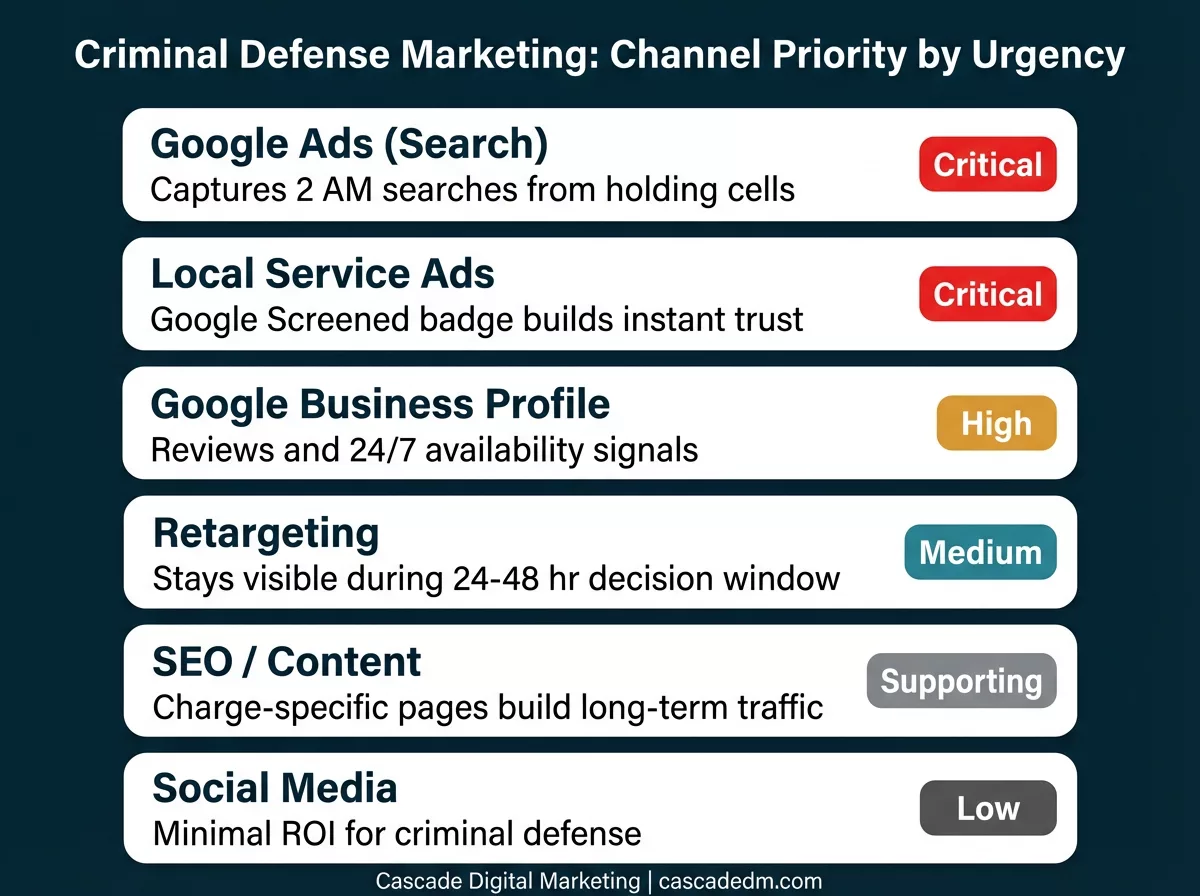
This isn’t a template. Your market, your budget, and your firm’s specific strengths will change the details. But the priority sequence is almost always the same: intake process, then paid search, then retargeting, then SEO, then content. Every layer builds on the one before it.
Frequently Asked Questions
How much should a criminal defense firm spend on marketing?
Most criminal defense firms generating meaningful results spend between $5,000 and $15,000 per month on marketing, with the majority allocated to Google Ads and LSAs. The right number depends on your market’s competitiveness, your average case value, and how many new cases you want per month. Here’s a simple framework: if your average retained case is worth $5,000 in fees and your target cost per acquisition is $500, you need 10 clicks to generate one case at $50 per click. Wanting 20 new cases per month at that rate requires $10,000 in ad spend alone. Add management fees, landing page optimization, and retargeting, and you’re in the $12,000 to $15,000 range. Start with what you can sustain for 6 months without panic, then scale based on actual ROI data.
Why do criminal defense Google Ads cost so much per click?
Criminal defense keywords are among the most expensive in all of Google Ads because the client lifetime value is high and the intent is immediate. When someone searches “criminal defense lawyer near me,” they’re likely retaining a firm within hours. That immediate conversion potential makes every click extremely valuable, which drives up competition among firms bidding on those terms. A $100 click that converts to a $7,500 case is a 75x return. The cost per click reflects the economics of the practice area, not a Google pricing error. The firms that struggle with cost aren’t paying too much per click. They’re converting too few clicks into retained cases, usually because of landing page issues or intake failures.
Can SEO replace Google Ads for criminal defense marketing?
Eventually, partially. A strong SEO presence can reduce your dependence on paid ads over time, but it won’t fully replace them for criminal defense. Here’s why: the top positions in criminal defense search results are dominated by ads (LSAs, then Google Ads, then the map pack, and then organic results). By the time a searcher reaches the organic listings, they’ve already seen 6 to 8 paid placements. For high-urgency searches, most clients click one of the top results and call. Organic rankings are valuable for building a steady baseline of inquiries and for capturing informational searches that convert later. But the highest-intent, most-urgent searches will always have a paid component. The best strategy uses both: paid search for immediate capture, SEO for long-term compound growth.
Should I hire a marketing agency or do criminal defense marketing in-house?
If you have the budget, hire an agency that specializes in law firm marketing and has specific experience with criminal defense. The difference between a general marketing agency and one that understands the urgency dynamics, bar compliance requirements, and channel priorities of criminal defense is the difference between profitable growth and expensive experimentation. Ask any agency you’re considering: how many criminal defense firms do you work with? What’s the average cost per retained client for those firms? Can you show me actual results? If they can’t answer those questions with specifics, they’re learning on your budget. In-house works if you have someone who can manage Google Ads, track conversions, optimize landing pages, and stay current on ad platform changes. Most firms don’t have that person, and the cost of hiring one exceeds the cost of an experienced agency.
Cascade Digital Marketing builds practice-area-specific strategies for criminal defense firms. No recycled templates. No guesswork. If your firm is ready to turn digital channels into a consistent source of retained cases, let’s talk.


