

By Josh Kilen
Here’s a number that should get your attention: the average keyword difficulty for accounting firm marketing terms is under 15 out of 100. In legal marketing, those same types of terms score 40 to 60. In dentistry and med spa marketing, 25 to 35. The accounting industry is one of the least competitive spaces in all of professional services marketing. And the reason is simple. Most CPA firms have never needed to market themselves.
Referrals built your firm. They filled your client roster for ten, twenty, thirty years. A banker sent business owners your way. An attorney referred estate clients. That system worked because accounting was stable, relationship-driven, and predictable.
That system is breaking. Not because referrals stopped working. Because everything around them changed.
Private equity is consolidating the industry. Retiring partners are walking out with relationships that took thirty years to build. The next generation of business owners finds their CPA the same way they find everything else: Google search, online reviews, and the first firm that looks credible and makes it easy to schedule a call.
This guide is the complete accounting firm marketing playbook for firms that want to build a predictable growth engine alongside referrals. I’ll cover every channel that matters, what to spend, how to measure what’s working, and why the firms that move now will own positions that become dramatically harder to claim later.
The State of Accounting Firm Marketing in 2026
The accounting industry is in the middle of a structural transformation, and most firm owners are too busy with client work to notice the implications for growth.
Private equity acquisitions are reshaping the competitive landscape. Firms like EisnerAmper, Baker Tilly, and dozens of mid-market practices have taken PE money in the last three years. These PE-backed firms have marketing budgets, professional branding, and growth mandates. They’re targeting the same mid-market clients that local firms have served for decades.
The talent crisis is accelerating retirements. Fewer students are entering accounting, more CPAs are reaching retirement age, and the pipeline can’t keep up. When a senior partner retires, their client relationships don’t transfer cleanly. Some clients follow the partner. Others use the transition to shop around. A firm that relies on partner-held relationships for all its new business is one retirement away from a contraction.
Buyer behavior has shifted permanently. A business owner under 50 does not ask their Chamber of Commerce contact for a CPA referral. They search Google, check reviews, and contact the firm that communicates competence. Research from Hinge Marketing consistently shows that high-growth professional service firms invest significantly more in marketing than their slower-growing peers.
The firms that build a marketing system now will own the digital real estate in their markets. The firms that wait will find the positions worth claiming already taken.
Why Referrals Alone Are No Longer Enough
I’ve had this conversation with dozens of managing partners. When they ask me how to market an accounting firm, I start by asking three questions.
What happens when your top referral source retires? Most firms have two or three people who generate the majority of their referral business. When one retires, changes firms, or stops referring, the pipeline goes quiet with no warning. You’re starting from zero at the exact moment you need leads the most.
Can you choose which clients and service lines to grow? A firm running on referrals takes whatever walks through the door. You want to grow advisory but your referrals keep sending individual returns. Referrals are unpredictable in volume and uncontrollable in quality. Marketing lets you target specific industries, service lines, and client types.
Can you project your revenue twelve months out? Hiring, office expansion, technology investment, partner tracks. All depend on predictable revenue. Referrals are not predictable. You can’t invest $5,000 in referrals next month and get more of them. A marketing system gives you the lever that referrals never will.
The risk isn’t that referrals stop being valuable. They’re the highest-converting lead source in professional services and you should keep earning them. The risk is concentration. A firm that derives 80% to 90% of new business from referrals has a single point of failure. Marketing builds the second pipeline.
The Complete Marketing Stack for Accounting Firms
What follows is the full stack, in priority order. Not every firm needs every channel. But understanding the complete picture helps you decide where to invest based on your firm’s size, goals, and competitive environment.
1. Brand Positioning: The Foundation Everything Else Builds On
Before you build a website, run an ad, or write a blog post, you need to answer one question: what makes your firm different from the six other accounting firms within ten miles?
If the answer is “we provide great client service and we’re responsive,” that’s not positioning. Every firm says that. Positioning means making a choice about who you serve, what you’re known for, and what you deliberately don’t do.
The most successful accounting firms in marketing share a common trait: specificity. They don’t position as “full-service accounting firms.” They position as:
- The firm that specializes in construction contractor accounting
- The bookkeeping practice built for restaurants and hospitality
- The CPA firm that works exclusively with medical practices
- The advisory firm for real estate investors and property managers
- The accounting partner for e-commerce and DTC brands
Specialization is not a limitation. It’s a marketing multiplier. I’ll cover why in detail later in this guide, but the short version: a firm that specializes in restaurant accounting can rank for “restaurant accountant [city]” in weeks because nobody else is targeting that keyword. A generalist firm competing for “accountant [city]” is fighting every other firm in the market for the same position.
Your marketing strategy starts with getting clear on positioning. Everything downstream, your website messaging, your content topics, your ad targeting, your email content, flows from this decision.
2. Website: Your 24/7 Partner
Your website is where prospects decide whether to call or click back to the search results. In accounting, the decision to call often comes down to three things: does this firm seem competent, does it seem trustworthy, and is it easy to take the next step?
Most accounting firm websites fail on at least two of those three. They use jargon that means nothing to a business owner. They bury the contact information. They have no dedicated service pages. What a strong accounting firm website requires:
Dedicated service pages for every major offering. Tax preparation. Bookkeeping. Payroll. Tax planning. Business advisory. Each service gets its own page, written for clients, not for other accountants. Google can’t rank you for “small business bookkeeping services” if that phrase appears once in a bullet list on a generic page.
Industry pages if you serve specific sectors. If you work with construction companies, restaurants, medical practices, or nonprofits, each deserves a dedicated page. These rank for niche keywords and immediately signal relevance to the visitor.
Team bios with photos, credentials, and specialties. People hand over their most sensitive financial information to their CPA. Names, faces, and real backgrounds build trust faster than any amount of marketing copy.
Clear next steps. A prominent “Schedule a Consultation” button. A contact form that doesn’t require twelve fields. A phone number visible on every page. Every barrier between “I’m interested” and “I made contact” costs you leads.
Trust signals above the fold. CPA licensure. AICPA membership. State society membership. QuickBooks ProAdvisor. Industry certifications. Number of years in practice. These aren’t vanity badges. In a regulated profession, they’re proof of qualification.
When we worked with Sound Accounts, a bookkeeping and payroll firm in the Tacoma area, the firm had strong expertise but virtually no online presence. We built a professional website with clear service pages, an approachable brand identity, and conversion-focused copywriting. The result: Sound Accounts doubled their client inquiries. Not over two years. Quickly. Because when you go from invisible to visible in an industry where most competitors have terrible websites, the impact is immediate.
3. SEO: The Long Game That Compounds
Search engine optimization is where accounting firms have the single largest untapped opportunity in professional services marketing. I wrote an entire guide on accountant SEO that goes deep on keyword strategy, seasonality, and implementation. Here I’ll cover the strategic framework.
The numbers are striking. “CPA near me” generates over 33,000 searches per month nationally. “Tax accountant near me” gets 18,000+. “Bookkeeping services near me” gets 12,000+. And the keyword difficulty for virtually all of these terms is under 10 out of 100. In law, comparable terms score 40 to 60. In dentistry, 25 to 35. Accounting is competing in an almost empty field.
Your SEO strategy for an accounting firm should focus on three layers:
Local service keywords (highest intent). “CPA [city].” “Small business accountant [city].” “Bookkeeping services [city].” These are the searches people make when they’re ready to hire. Every one represents a potential client. A firm that ranks for these terms in their market will generate a steady stream of consultations.
Service-specific keywords (high intent). “Nonprofit accounting services.” “Construction bookkeeping.” “Tax planning for business owners.” Each of these should map to a dedicated page on your website.
Educational keywords (pipeline building). “How much does a CPA cost.” “When to hire a bookkeeper vs a CPA.” “S-corp vs LLC for taxes.” These are the questions your future clients type into Google before they know they need you. Publishing clear, authoritative answers builds your firm’s topical authority and introduces prospects to your brand at the beginning of their decision process.
The seasonality of accounting creates a natural content calendar. Tax-related content published in November and December ranks in time for the January-through-April search surge. Advisory content published throughout the year captures the planning-stage searches that happen after tax season. This cycle repeats annually, and each year of consistent publishing builds on the authority established the year before.
4. Google Ads: High-Intent Capture
Google Search Ads put your firm in front of people who are actively searching for an accountant right now. The cost per click for accounting keywords is significantly lower than for legal or medical terms, typically $5 to $25 per click for high-intent searches like “CPA near me” or “business accountant [city],” compared to $50 to $150+ for equivalent legal keywords.
Google Ads make sense for accounting firms in specific situations:
- Competitive metro areas where organic rankings will take months to build and you want visibility now
- Tax season surge when search volume spikes and you have capacity to take on new clients
- High-value service lines like business advisory, M&A due diligence, or CFO services where a single new client justifies months of ad spend
- New firm launches or new locations that need immediate market presence
The critical requirement: conversion tracking. Every click needs to be traceable through to a consultation request. If you can’t tell which keywords generate signed clients, you’re guessing. And guessing at $15 per click adds up fast.
For most firms, Google Ads should come after the website and SEO foundation are in place. Running ads to a website that hasn’t been updated since 2016 is paying to send people to a bad first impression faster. Fix the destination before you start driving traffic to it.
5. Google Business Profile: Where Most Local Clients Start
When someone searches “CPA near me” or “accountant [city],” Google shows three local businesses in the Map Pack at the top of the results, above the organic listings. If your firm isn’t in that Map Pack, you’re invisible for the highest-intent local searches in your market.
Your Google Business Profile (GBP) is the single most important piece of your local visibility strategy. And it’s free.
Complete every field. Business name, address, phone, hours, services, description, photos. Google prioritizes thoroughly completed profiles. An incomplete profile signals a disengaged business.
Choose precise categories. Primary category: “Certified Public Accountant” or “Accounting Firm.” Secondary categories for specific services: “Tax Preparation Service,” “Bookkeeping Service,” “Payroll Service.” Categories determine which searches trigger your listing.
Earn reviews systematically. Reviews are the primary differentiator in the Map Pack. Ask clients to mention specific services in their review. “They handled our payroll migration and quarterly filings” outperforms “Great service” because it tells Google (and future clients) exactly what you do. A firm with 50 detailed reviews will outrank a firm with 12 generic ones, all else being equal.
Post regularly. Tax deadline reminders. New service announcements. Team updates. Regulatory changes that affect clients. GBP posts keep your profile fresh and signal to Google that the business is active and engaged.
6. Email Marketing: Retention, Referrals, and Revenue
Email is the most underutilized channel in accounting firm marketing. Most firms either don’t email their clients at all, or send one tax-deadline reminder per year. That’s leaving revenue on the table.
Email marketing for accounting firms serves three functions:
Client retention. A monthly newsletter keeps clients engaged between touchpoints. When they hear from you monthly, you’re top of mind when their business partner asks “do you know a good accountant?”
Referral generation. Every useful email is an opportunity for a satisfied client to forward it to a colleague. Content that helps gets forwarded. Generic holiday greetings do not.
Service line expansion. Your tax clients may not know you offer CFO advisory. Your bookkeeping clients may not know you do tax planning. A single email about year-end strategies that mentions your advisory services can generate more qualified conversations than a month of cold outreach.
The content for accounting firm email practically writes itself. Tax law changes every year. Contribution limits change. Filing deadlines shift. Regulatory requirements evolve. Each of these is an email your clients need, written by someone they already trust. Bundle that with content marketing on your blog and you have a system where every piece of content serves double duty.
7. LinkedIn: The One Social Platform That Matters
For B2B accounting firms, LinkedIn is the only social media platform worth sustained investment. Your clients are there. Your referral sources are there. The business owners searching for a CPA are there. Facebook, Instagram, and TikTok are not where managing partners of construction firms or CFOs of mid-market companies make professional hiring decisions.
A LinkedIn strategy for accounting firms doesn’t require posting every day or building a massive following. It requires three things:
Complete, professional profiles for every partner and senior staff member. Individual profiles get more visibility than company pages on LinkedIn. When a partner posts about tax planning for contractors, it reaches the exact business owners who need that help.
Consistent posting of useful, non-promotional content. Tax tips. Industry insights. Regulatory updates. The goal is establishing individual CPAs as knowledgeable professionals. The selling happens when someone who’s seen your content three times realizes they need help.
Strategic connection building. Connect with local business owners, attorneys, financial advisors, and bankers. LinkedIn accelerates the relationship-building that used to happen exclusively at networking events.
8. Content Marketing: Thought Leadership That Drives Revenue
Content marketing works best layered on top of a solid website and SEO foundation.
Accounting firms have a natural advantage in content marketing that most industries would envy: the tax code changes every year. New brackets, new deduction rules, new filing requirements, new compliance obligations. Each change generates search volume from business owners who need to understand what it means for them.
Beyond regulatory content, accounting firms can publish:
- Industry-specific tax guides that attract exactly the clients you want: “Tax Deductions for Construction Companies,” “Accounting for Restaurant Owners,” “Tax Planning for Real Estate Investors”
- Decision-stage content that captures people ready to hire: “How to Choose Between an S-Corp and LLC,” “When to Hire a Bookkeeper vs a CPA,” “What Does a CPA Do for Small Business?”
- Comparison content that positions your firm in the consideration set: “CPA vs. DIY Tax Software: When Does It Make Sense to Hire a Professional?”
Each article builds topical authority, introduces prospects to your brand, and generates traffic for years. A single guide about retirement contribution limits can be updated annually with new numbers and generate traffic for as long as your website exists.
Specialization: The Marketing Multiplier Nobody Uses
This is the single most valuable piece of strategic advice in this entire guide: accounting firms that specialize dramatically outperform generalist firms in marketing.
There are roughly 86,000 CPA firms in the United States. Almost all position themselves as “full-service.” When every firm competes for the same broad keywords, cost and difficulty go up and results go down.
Now consider the firm that specializes in accounting for dental practices. Or construction contractors. Or restaurants. The keyword “restaurant accountant [city]” has almost no competition. Zero firms in most metros explicitly target it. The search volume is lower than “CPA near me,” but the intent is specific, the conversion rate is higher, and the client lifetime value is significant.
Specialization works because of three compounding effects:
You can dominate your niche keywords. A firm targeting “construction accounting [city]” can realistically rank on page one within months. A firm targeting “accountant [city]” is competing with everyone.
Your messaging resonates at a deeper level. When a restaurant owner lands on a page that says “We work with restaurants. We understand your tip reporting, food cost ratios, and sales tax complexity,” they feel understood in a way that “We serve businesses of all sizes” never achieves. That feeling of being understood is what converts visitors into consultations.
Your referral network tightens. A firm known as the construction accountant gets referred by construction attorneys, construction lenders, and construction supply companies. A generalist firm gets generic referrals from generic sources. The specialized firm’s referral network amplifies its marketing.
The firms that combine specialization with the marketing stack above are the ones generating outsized growth. They’re not spending more. They’re spending smarter, because every dollar goes toward reaching a precisely defined audience that nobody else is targeting.
The Competitive Landscape: Wide Open
I always tell clients to understand who they’re competing against before investing in marketing. In accounting firm marketing, the competitive analysis is almost comically simple.
BuildYourFirm is essentially the only dedicated marketing agency focused on accounting firms. Beyond them, the field is sparse. A few template providers. A handful of generalist agencies that list “CPA firms” as one of twenty industries they serve.
Compare that to law firm marketing, where dozens of dedicated agencies, multiple SaaS platforms, and an entire ecosystem of consultants and conferences compete for every dollar. The legal marketing industry is mature. The accounting marketing industry barely exists.
The firms that invest now will establish positions that become progressively harder to challenge. First-mover advantage is real in SEO: Google rewards domain age, content history, and accumulated authority. A firm that starts building today compounds that advantage every month.
Budget Reality: What to Spend at Different Firm Sizes
Marketing budgets for accounting firms should be calibrated to firm size, growth goals, and competitive environment. Here’s what realistic investment looks like:
Small Firms (1-5 CPAs): $1,000 to $3,000 per month
At this level, you’re investing in essentials. A professional website (one-time investment of $8,000 to $15,000, then monthly maintenance). Google Business Profile optimization. Basic SEO. One to two blog posts per month. Monthly email newsletter. Enough to build local visibility and start generating organic leads within six to twelve months.
Priority: do fewer things well. A firm spending $2,000/month on website, SEO, and content will outperform a firm splitting the same amount across five half-funded channels.
Mid-Size Firms (5-20 CPAs): $3,000 to $8,000 per month
Add layers: aggressive content production, Google Ads for high-intent keywords, LinkedIn for partners, email nurture sequences, and conversion optimization. This budget supports a multi-channel strategy with measurable, attributable growth.
Mid-size firms often benefit most from marketing because they have infrastructure to handle new volume but lack brand recognition to attract it. Marketing closes that gap.
Larger Firms (20+ CPAs): $8,000 per month and above
Full marketing operation: dedicated content production, multi-channel advertising, industry-specific campaigns, thought leadership, and ongoing optimization. Clear attribution tracking connecting spend to signed clients and revenue is non-negotiable at this level.
At every tier, the principle is the same: invest in channels that produce attributable results, measure everything, and scale what works.
Measuring Marketing ROI for Accounting Firms
The economics of marketing for accounting firms are favorable because of one number: client lifetime value.
A business client paying for monthly bookkeeping, quarterly filings, and annual tax preparation generates $3,000 to $8,000 per year. Advisory, audit, and CFO services push that to $10,000 to $15,000+ annually. And accounting client relationships last decades. A client acquired in year one generates revenue for five, ten, or fifteen years.
That means a single new business client acquired through marketing could be worth $15,000 to $75,000+ over the lifetime of the relationship.
The benchmarks to track:
- Cost per lead (CPL): For accounting firms running Google Ads, expect $50 to $200 per lead depending on market and keyword. SEO-generated leads get cheaper over time as organic traffic builds without per-click cost.
- Cost per acquisition (CPA): If your close rate on consultations is 40% and your CPL is $100, your CPA is $250. That’s exceptional when the client is worth $5,000+ per year.
- Client lifetime value (CLV): A $250 acquisition cost for a client worth $50,000 over ten years is a 200x return. This is the number that justifies your marketing investment.
- Channel attribution: Which channels generate your highest-value clients? The channel producing construction company clients worth $12,000/year is more valuable than the one generating individual returns worth $400/year, even with fewer leads.
If you’re working with a marketing agency and they can’t tell you your cost per lead and cost per acquisition by channel, they’re not measuring what matters.
The Damaging Admission: Accounting Is 3 to 5 Years Behind
I’ll be direct: the accounting industry is three to five years behind law firms in digital marketing sophistication. Most CPA firms have websites that look like they were built during the Obama administration. Content marketing is nonexistent. Google Ads are a novelty. Email marketing, if it happens at all, consists of a single “tax season is coming” blast in January.
That sounds bad. It’s actually the best news in this entire guide.
The law firms that dominate search today started investing seriously around 2018 to 2020. It took three to five years of consistent work through a competitive landscape with dozens of agencies driving up costs. An estate planning firm that started SEO in 2019 spent years fighting for rankings against well-funded competitors.
Accounting firms face none of that. The keyword difficulties are a fraction of legal terms. The agency ecosystem hasn’t developed. A CPA firm that invests in marketing today can achieve in six to twelve months what took law firms three years.
That window is closing. As PE money flows in and more agencies discover the opportunity, difficulty scores will climb. But right now, the economics are as favorable as they’ve ever been.
If you want a detailed look at how SEO specifically plays out for accounting firms, including keyword data, seasonality strategy, and implementation steps, read our guide on accountant SEO. For a detailed CPA firm marketing strategy, our upcoming guide on CPA firm marketing covers the nuances of positioning, compliance, and channel selection for licensed practices.
Compliance: What Accounting Firms Need to Know
One genuine advantage of accounting firm advertising: the regulatory burden is lighter than it is for most other regulated professions.
Law firms deal with state bar advertising rules that vary by jurisdiction and restrict everything from testimonials to specialization claims. Medical practices navigate HIPAA. Financial advisors operate under SEC and FINRA rules.
Accounting firms have fewer restrictions. No pre-approval requirements. No blanket prohibition on testimonials. No mandatory disclaimers on most marketing materials.
The primary regulation to be aware of is Circular 230, the Treasury Department regulations governing practice before the IRS. Circular 230 applies to tax-related marketing claims and includes provisions about:
- Not making false or misleading statements about your qualifications or the services you provide
- Not making claims about tax results that are unlikely or unsubstantiated
- Not using coercive or harassing tactics to acquire clients
- Including appropriate disclaimers on written tax advice
In practice, Circular 230 requires what you’d want to do anyway: be honest about your qualifications, don’t promise specific tax outcomes, and don’t mislead potential clients.
State boards of accountancy may have additional rules about firm names and CPA designation use. Worth reviewing before launching a significant campaign, but generally far less restrictive than legal advertising rules.
The bottom line: compliance is a consideration, not a barrier. The firms that aren’t marketing aren’t abstaining because of regulatory concerns. They’re abstaining because they’ve never needed to. That’s changing.
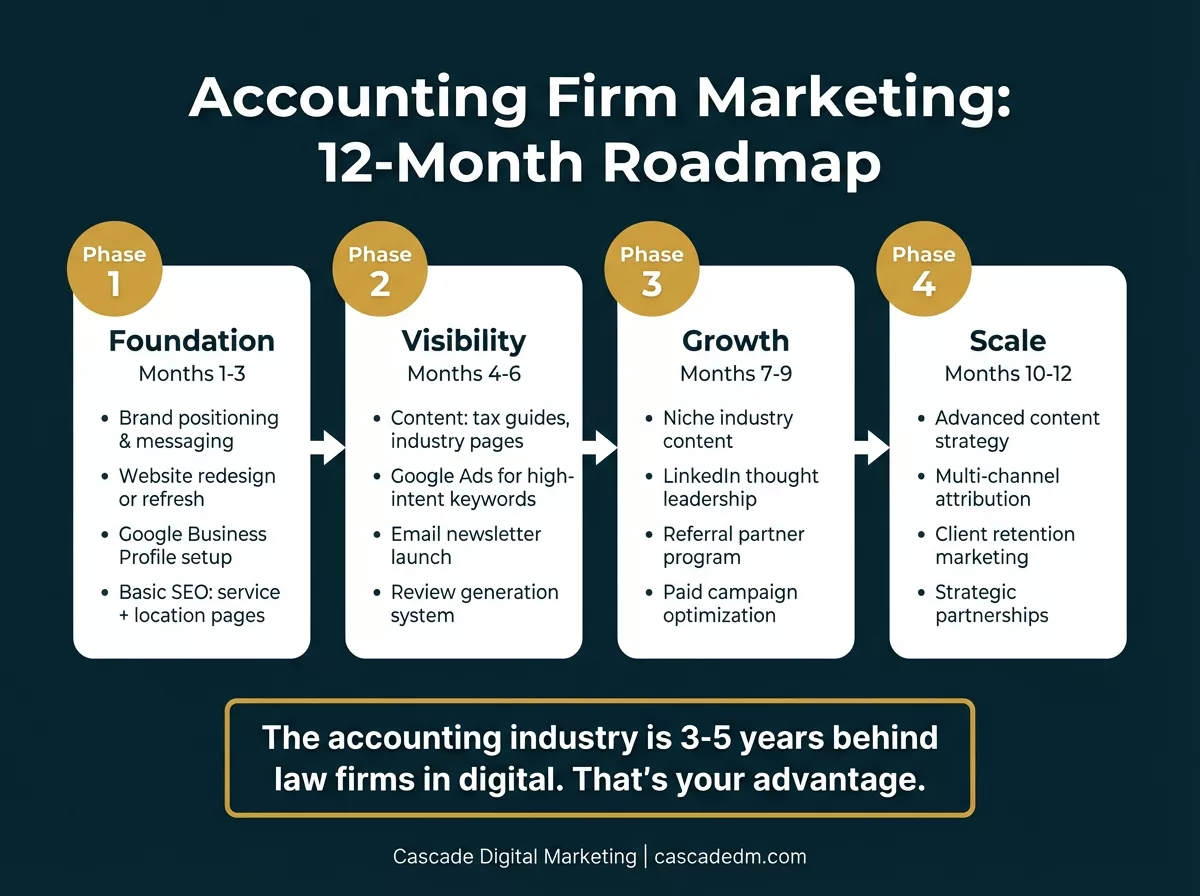
A 12-Month Implementation Roadmap
For firms ready to build a marketing system, here’s what a responsible implementation timeline looks like:
Months 1-2: Research and Foundation
- Competitive analysis: what are the top-ranking firms in your market doing? Where are the gaps?
- Keyword research: which terms have search volume and low competition in your metro?
- Brand positioning: define your specialization, ideal client profile, and core messaging
- Website audit: assess what needs to be rebuilt versus improved
- Analytics setup: install tracking so everything that follows is measurable
Months 3-4: Build and Launch
- Website redesign or overhaul (if needed) with dedicated service pages, industry pages, team bios, and clear conversion paths
- Google Business Profile optimization: complete all fields, select precise categories, begin review generation
- First round of SEO content: 4-6 pages targeting your highest-priority keywords
- Email list segmentation and first monthly newsletter
Months 5-8: Growth and Optimization
- Monthly content publishing (2-4 articles per month) building topical authority
- Google Ads launch for high-intent keywords if budget allows
- LinkedIn strategy activation for partners and senior staff
- First round of data-driven adjustments based on what the analytics show
- Email nurture sequences for different client segments
Months 9-12: Compounding
- Organic traffic building as content library grows and pages age
- Paid campaigns getting more efficient as data accumulates
- Review count growing, strengthening Map Pack positioning
- Clear picture of which channels generate the highest-value clients
- Budget reallocation from underperforming channels to proven ones
The firms that follow this timeline and resist the urge to abandon ship at month three are the ones that build real marketing assets. The ones that start and stop, start and stop, never get past the foundation.
Frequently Asked Questions
How much should an accounting firm spend on marketing?
The AICPA suggests 2% to 5% of revenue, but that range is too broad. A better framework: $1,000 to $3,000/month for small firms (1-5 CPAs), $3,000 to $8,000 for mid-size (5-20 CPAs), $8,000+ for larger practices. Start with an amount you can sustain for twelve months and scale based on measured performance. The worst approach is a big initial investment followed by cutting the budget when results haven’t materialized in 60 days.
How long does it take for accounting firm marketing to work?
Faster than you’d expect. Google Business Profile improvements affect local visibility within weeks. A well-structured website can begin ranking for local keywords within two to four months. Content compounds over six to twelve months. Google Ads generate leads from day one (assuming the website converts). Most firms see measurable lead generation increases within four to six months and revenue impact within eight to twelve months. Compare that to legal marketing, where twelve to eighteen months is standard.
What’s the most important marketing channel for accounting firms?
It depends on your firm, but for most practices, the priority order is: website, Google Business Profile, SEO, content marketing, then paid advertising. The website and GBP are non-negotiable foundations. SEO and content build a long-term pipeline. Paid advertising accelerates results once the foundation is working. If forced to pick one, I’d say your Google Business Profile, because it’s free, it drives the highest-intent local traffic, and it’s where most potential clients will encounter your firm first.
Should I hire a marketing agency or do it in-house?
Some elements can be handled internally. Your CPAs are the most credible people to write about tax law changes. But the technical components (website development, SEO architecture, Google Ads management, analytics) require specialized expertise. The hybrid model works well: content creation in-house, technical execution and strategy from an agency. The worst option is hiring a generalist agency that treats your CPA firm like a pizza shop.
What is CPA in digital marketing terms?
If you’ve come across “CPA” in a marketing context and wondered about the overlap with your profession, it stands for “cost per acquisition” in digital marketing. It measures how much you spend to acquire a single new client. Understanding this metric is foundational to measuring your marketing ROI. We cover this in detail in our guide on what CPA means in digital marketing.
Cascade Digital Marketing works with accounting firms and CPA practices to build the marketing systems that turn online visibility into qualified client consultations. If your firm is ready to grow beyond referrals, let’s talk. We’ll start with research into your market, your competition, and your growth goals, and build a strategy from what the data says will work.


