

By Josh Kilen
I’m going to tell you something that would make most marketing agencies uncomfortable: the accounting industry is almost completely uncontested in search engine optimization. The keyword difficulty for “accountant SEO” is 2.9 out of 100. For context, law firm SEO terms range from 20 to 50. Construction company SEO sits around 25. Accounting firms are competing in what is essentially an empty field.
In ten years of working with professional service firms, I have never seen an industry with this much low-hanging fruit. And the reason is simple: CPAs have never needed to market themselves. The entire client acquisition model for most accounting firms is referrals, word of mouth, and existing client relationships. That has worked for decades. But the firms that recognize the shift happening right now and invest in their online presence will own search positions that become exponentially harder to claim later.
This guide covers how accountant SEO actually works, what makes it different from SEO for other professional services, and why the window of opportunity is wider open than you probably realize.
The Referral Problem Nobody Talks About
Accounting is the most referral-dependent professional service industry in the country. Most CPAs I’ve spoken with estimate that 80% to 95% of their new clients come from referrals or existing client relationships. Many firms have never spent a dollar on marketing. Not because they tried it and it didn’t work. Because they never needed to try.
Here’s the part nobody talks about: referral pipelines have a lifespan.
The attorney who’s been sending you small business clients for fifteen years retires. The financial advisor who referred estate planning work relocates. Your biggest client sells their business and the new ownership brings their own accountant. A recession hits and the steady drip of new business formations slows to a trickle.
When referral sources dry up, they don’t give notice. One quarter the pipeline is full. The next quarter it’s quiet. And because you’ve never built any other channel, there’s no system to activate. You’re starting from zero at the exact moment you need leads the most.
Three patterns I see repeatedly:
- Invisible expertise. Your firm has deep experience in construction accounting, nonprofit audits, or tax planning for physicians. Nobody outside your existing network knows it. That specialization is worth real money in a Google search. Right now, it’s generating zero inbound leads.
- Growth ceiling. You want to add a partner, hire more staff, or expand into a new service area, but you can’t project the revenue because you can’t project the referrals. Growth planning requires a predictable lead source. Referrals aren’t predictable.
- Wrong-fit clients. You take whatever walks through the door because you can’t afford to be selective. A firm with a marketing engine can choose which clients and service lines to grow. A firm running on referrals takes what it gets.
Accountant SEO doesn’t replace referrals. Referrals are excellent and you should keep earning them. SEO builds a second pipeline alongside referrals so you’re never one retired attorney away from a dry quarter.
Why Accounting SEO Is Almost Completely Uncontested
I checked. Outside of BuildYourFirm.com, which has carved out a niche in accounting firm marketing, almost nobody is doing anything meaningful in this space. The major marketing agencies that serve law firms, construction companies, and medical practices have largely ignored accounting. And accounting firms themselves have invested almost nothing in their online presence.
The numbers tell the story:
- “Accountant SEO” keyword difficulty: 2.9 out of 100
- “SEO for accounting firms” keyword difficulty: under 5
- “CPA near me” monthly search volume: 33,000+
- “Tax accountant near me” monthly search volume: 18,000+
- “Bookkeeping services near me” monthly search volume: 12,000+
Compare that to law. “Personal injury lawyer” has a keyword difficulty above 60. “Criminal defense attorney” sits around 45. Law firms have been fighting over search positions for fifteen years. The result is a crowded, expensive battleground where new entrants need months of work and significant budgets to compete.
Accounting firms face none of that. A firm that builds a solid website, creates useful content, and optimizes for local search can realistically rank on page one within three to six months. Try doing that as a personal injury attorney. It would take years.
This window will not stay open forever. As more agencies discover the opportunity and more firms start investing, the difficulty scores will climb. But right now, first-mover advantage is real: Google rewards domain age, content history, and accumulated authority. The firms that start building today will have a compounding lead over firms that start in two or three years.
Keywords That Actually Generate Accounting Clients
The keyword strategy for SEO for accountants needs to focus on searches that indicate someone is looking for help, not just information. The keywords that generate accounting clients fall into three categories:
Service + Location Keywords (Highest Intent)
These are the searches people make when they’re ready to hire. They’ve already decided they need an accountant. Now they’re finding one.
- “CPA near me”
- “Tax accountant [city]”
- “Small business accountant [city]”
- “Bookkeeping services [city]”
- “Accounting firm [city]”
Every one of these keywords represents a person who is ready to make a call. If your firm doesn’t appear in these results, someone else gets that conversation. And because accounting SEO is so uncontested, ranking for these terms is dramatically easier than it would be in law or medicine.
Service-Specific Keywords (High Intent)
These searches indicate someone looking for a specific service, often at the point of making a decision.
- “Small business bookkeeping services”
- “Tax planning for business owners”
- “Payroll services for small business”
- “Business tax preparation”
- “Nonprofit accounting services”
- “Forensic accounting services”
Each of these should have a dedicated page on your website. Not a bullet point on a generic services page. A full page with a clear description of what you do, who it’s for, what the process looks like, and how to get started. Google can’t rank you for “nonprofit accounting services” if the phrase appears once in a list of twenty other services.
Educational Keywords (Pipeline Building)
These are the questions your future clients are typing into Google before they know they need you.
- “How much does a CPA cost”
- “When to hire an accountant vs do it yourself”
- “Do I need a bookkeeper or an accountant”
- “What does a CPA do for small business”
- “How to choose an accountant for my business”
- “Quarterly tax payments explained”
Educational content builds your firm’s authority in Google’s eyes and introduces potential clients to your firm at the beginning of their decision process. When they’re ready to hire three months later, they remember the firm that actually explained things clearly.
The Seasonality Challenge (And How to Use It)
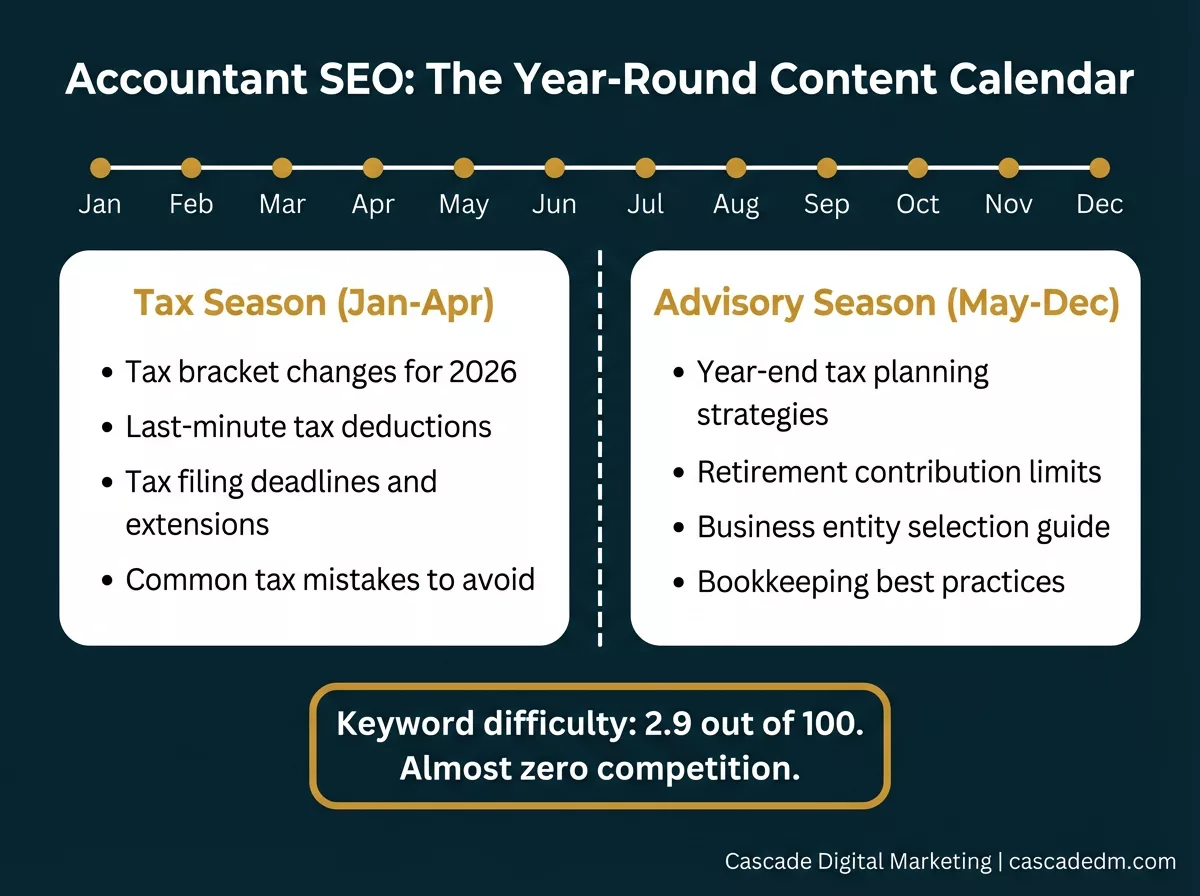
Accounting has the most extreme seasonality of any professional service. From January through April, every CPA in the country is drowning in tax work. From May through December, the pace changes completely and many firms shift to advisory, planning, and business services.
Most accounting firms that attempt marketing make the same mistake: they run a campaign during tax season (when they’re already too busy) and stop in the summer (when they actually need new business). That’s backwards.
Your accounting firm SEO strategy should run year-round, but the content and messaging should shift with the calendar.
January through April: Tax Season Content
This is when search volume spikes for tax-related queries. People are searching for help, and they’re searching with urgency.
- “Tax preparation services near me”
- “Last minute tax filing help”
- “Small business tax deductions 2026”
- “New tax bracket changes 2026”
- “How to file business taxes”
Publish this content in November and December so it has time to index and rank before the January rush. If you wait until February to write about tax season topics, you’ve already missed the wave.
May through December: Advisory and Planning Content
After tax season, search behavior shifts toward planning, strategy, and business growth.
- “Tax planning strategies for small business”
- “How to reduce my tax bill next year”
- “Business entity selection for tax purposes”
- “Retirement contribution limits 2027” (yes, people search for next year’s numbers as early as mid-year)
- “When to switch from sole proprietor to S-corp”
- “Year-end tax planning checklist”
This is also the window to publish content about your non-tax services: bookkeeping, payroll, CFO advisory, business valuation, succession planning. These services have lower search volume but higher client lifetime value, and the competition for these keywords is virtually nonexistent.
Google Business Profile: Where Most Accounting Clients Start
Here’s a fact that surprises many accounting firm owners: most of your potential clients will find you through the Google Map Pack before they ever visit your website. When someone searches “CPA near me” or “accountant [city],” Google shows three local businesses at the top of the results, above the organic listings. If you’re not in that map pack, you’re invisible for the highest-intent searches in your market.
Your Google Business Profile (GBP) is the single most important piece of your local SEO strategy. And unlike your website, it’s free to set up and maintain. Here’s what matters:
Complete every field. Business name, address, phone, hours, services, business description, photos. Google gives priority to thoroughly completed profiles. A half-finished profile signals a half-engaged business.
Choose the right categories. Your primary category should be “Certified Public Accountant” or “Accounting Firm.” Add secondary categories for specific services: “Tax Preparation Service,” “Bookkeeping Service,” “Payroll Service.” These categories directly affect which searches trigger your profile.
Reviews are your competitive advantage. Reviews from business owners carry particular weight in accounting. A testimonial from a restaurant owner or contractor carries more credibility than a generic five-star rating. Ask your best clients to leave reviews that mention the specific service you provided. “Sound Accounts handled our payroll migration and quarterly tax filings” tells Google and potential clients far more than “Great service, highly recommend.”
Post regularly. Google Business Profile has a posting feature most businesses ignore. Post about tax deadline reminders, new service offerings, or regulatory changes. Posts keep your profile fresh and signal to Google that the business is active.
Keep hours accurate. Google downgrades profiles with inaccurate hours. During tax season, if your firm has extended hours, update the profile. Accuracy builds trust with both Google and potential clients.
Website Requirements for Accounting Firms
Your website is where prospects decide whether to call or click back to the search results. Accounting is intimidating to most people. Small business owners searching for a CPA feel out of their depth, worried about cost, worried about being judged for the state of their books.
Your website needs to be professional but approachable. Here’s what that means:
Dedicated service pages for every major service. Tax preparation. Bookkeeping. Payroll. Tax planning. Business advisory. Audit. Each gets its own page written for clients, not other accountants. “We provide comprehensive attestation services including compilations, reviews, and audits” means nothing to a business owner. “We prepare the financial reports your bank, investors, or board of directors require” does.
A clear explanation of who you serve. If you specialize in construction companies, medical practices, or restaurants, say so on your homepage and on dedicated industry pages. Specialization is a ranking factor and a trust signal.
A pricing indicator. You don’t need to publish your fee schedule. But addressing cost, even with ranges, immediately reduces the anxiety that keeps people from calling. “Individual tax preparation starts at $300; small business returns vary by complexity” is more useful than making someone guess.
Trust signals above the fold. CPA licensure, professional memberships (AICPA, state society), years of experience, number of clients served. On an accounting website, these aren’t vanity metrics. They’re proof of qualification in a regulated profession.
Client portals and secure document upload. These aren’t marketing features in the traditional sense. But they signal professionalism, especially to younger business owners who expect digital interactions. If your onboarding process involves mailing paper forms, you’re losing clients to firms that offer a portal.
The overall goal: a website that makes a stressed-out small business owner feel like they’ve found a competent, trustworthy firm. Not a website that makes them feel like they need an accounting degree to understand what you do.
Content Marketing: Your Unfair Advantage
Of all the professional service industries I work with, accounting firms have the strongest natural advantage in content marketing. Tax law changes constantly. Every year brings new rules, new limits, new deductions, new compliance requirements. That creates an endless stream of high-intent content opportunities that reset annually.
The content practically writes itself:
- “2026 tax bracket changes: what it means for your business”
- “New QBI deduction rules: who qualifies and who doesn’t”
- “2027 retirement contribution limits for business owners”
- “Changes to 1099 reporting requirements”
- “How the new corporate transparency act affects small businesses”
Every one of these spikes every year. Right now, most of these queries are answered by generic tax advice sites, not by local accounting firms. When a CPA publishes authoritative content about a tax law change, the article ranks (because an actual CPA writing about tax is exactly what Google’s E-E-A-T framework rewards) and the people who read it realize they need professional help. Your contact page is one click away.
Beyond regulatory changes, accounting firms have other rich content categories:
- Industry-specific tax guides. “Tax deductions for construction companies.” “Accounting for restaurants: what you need to know.” “Tax planning for real estate investors.” These attract exactly the clients you want.
- Decision-stage content. “How to choose between an S-corp and LLC.” “When to hire a bookkeeper vs a CPA.” “Is it time to outsource your payroll?” These answer questions people ask right before they hire someone.
- FAQ content. “Can I deduct my home office?” “What records do I need to keep for the IRS?” “How far back can the IRS audit?” These are high-volume, easy-to-rank questions that build topical authority.
Publish consistently, even one quality article per month, and organic traffic compounds over time. A single well-written article about retirement contribution limits can generate traffic every year, updated annually with new numbers, for as long as your website exists.
Why Paid Ads Are Usually Premature for Accounting Firms
I run ad campaigns for clients across multiple industries. I’m not anti-advertising. But for most accounting firms, paid ads should not be the first investment.
The search volume for accounting services is modest compared to legal or home services. In a mid-size metro, “CPA near me” might get 500 to 1,000 searches per month. “Accountant [city]” might get 200 to 400. The organic opportunity is large enough, and uncontested enough, that SEO and Google Business Profile should come first.
Paid ads make sense in specific scenarios:
- Competitive metro areas where multiple firms are already running ads and organic rankings will take time to build
- High-value specialty services like business advisory, forensic accounting, or M&A due diligence where one client justifies the ad spend
- New firm launches that need immediate visibility while building organic presence
- Tax season surge when you have the capacity to take on additional clients and want to capture seasonal demand
For most firms, the priority sequence is: website, Google Business Profile, SEO, content, then paid ads. Each layer builds on the one before it. Running Google Ads to a website that hasn’t been updated since 2018 is just paying to send people to a bad first impression faster.
A Quick Case Study: Sound Accounts
Sound Accounts had strong expertise, a solid team, and loyal existing clients. But they had zero online visibility. No meaningful website. No search presence. No content. Every new client came from referrals, and the partners wanted to grow beyond what referrals alone could support.
We started with research: what potential clients in their market were searching for, what the competition was doing (very little), and where the gaps were widest. We built a professional website with clear service pages, an approachable brand identity, and content that spoke to small business owners in plain language.
The result: Sound Accounts doubled their client inquiries after launching the new site and SEO strategy. Not over two years. Quickly. Because when you go from invisible to visible in an industry where almost nobody is visible, the impact is immediate.
In a competitive industry like law, doubling inquiries from SEO takes significant time and investment. In accounting, the barrier to entry is so low that firms see results faster simply because the competition hasn’t shown up yet.
What We’d Honestly Tell You in a First Meeting
Here’s what I’d actually tell you if we sat down together:
You probably need a better website before you need SEO. This is the uncomfortable truth. If your website looks like it was built in 2012, has no dedicated service pages, and features a stock photo of someone using a calculator next to a pile of paper, SEO will just send more people to a bad first impression. The website comes first. Always.
Your “About” page matters more than you think. People hand over their most sensitive financial information to their CPA. They want to know who they’re working with. A generic about page with corporate speak and no photos tells potential clients nothing. Individual bios with photos, credentials, and specialties build the trust that drives conversions.
Marketing won’t fix a positioning problem. If your firm does individual returns, small business accounting, payroll, audit, and forensic work with no clear focus, marketing can’t create a coherent message from that. The most successful accounting firms in search have a defined primary audience: small businesses, real estate investors, medical professionals. Get clear on who you serve best before investing in marketing.
Consistency matters more than perfection. Publishing one solid blog post per month for twelve months beats publishing five posts in January and nothing for the rest of the year. Google rewards consistency. Your audience rewards consistency. Start with a pace you can maintain and don’t stop.
This is a 12-month commitment, minimum. SEO and content marketing compound over time. If you need ten new clients next month, call your referral network. Marketing builds the pipeline for the next twelve months and beyond. The firms that struggle most are the ones that start, get impatient at month three, and stop. Then they start again a year later and wonder why it’s not working.
Frequently Asked Questions
How much does SEO cost for an accounting firm?
Most accounting firms should expect to invest between $1,500 and $4,000 per month for a comprehensive SEO and content strategy. That typically includes technical SEO, Google Business Profile optimization, monthly content creation, and keyword monitoring. Some firms start with a one-time website project ($8,000 to $20,000 depending on scope) and then move to monthly SEO. The investment is modest compared to other professional services because the competition is so low. You don’t need an aggressive link-building campaign to rank in accounting. You just need to show up consistently.
How long does it take for accounting firm SEO to produce results?
Because accounting SEO is so uncontested, results come faster than in more competitive industries. Most firms see measurable increases in organic traffic within two to four months. Ranking on page one for local service keywords (like “CPA [city]”) is realistic within three to six months for firms in mid-size markets. Client inquiries from organic search typically follow within four to eight months. Compare that to legal SEO, where page-one rankings for competitive terms can take twelve to eighteen months. The low competition in accounting compresses the timeline significantly.
Should I focus on SEO or Google Ads first?
SEO first, almost always. The search volume for accounting services in most markets is low enough that organic rankings can capture the majority of available traffic. Google Ads makes sense as a supplement, not a foundation, particularly during tax season or for specific high-value services. The exception is brand-new firms in competitive metros that need immediate visibility while building organic presence. Even then, the ad budget should be modest and the real investment should go toward building the website and content that will generate leads without ongoing ad spend.
Can I do accounting firm SEO myself?
Some of it, yes. Setting up your Google Business Profile, writing blog posts about tax law changes, and asking clients for reviews are all things you can do without an agency. The technical elements (site architecture, page speed, schema markup, strategic content planning) typically require expertise. Many firms find a hybrid approach works: handle content creation internally (you’re the tax expert, after all) and bring in an agency for the technical SEO and strategy. The key is consistency. Block time for it monthly and treat it like a recurring client obligation.
Cascade Digital Marketing works with accounting firms and CPA practices to build the online presence, SEO strategy, and content systems that turn search traffic into qualified clients. If your firm is ready to grow beyond referrals, let’s talk.


