

By Josh Kilen
Your best projects came from referrals. A past client mentioned your name at a planning meeting. An engineer you worked with five years ago sent someone your way. A developer remembered that healthcare facility you designed and called when their next project came up.
That pipeline has sustained your firm for years. Maybe decades. And because the work keeps coming, it feels like marketing is something other firms need. Firms that aren’t as good. Firms that have to sell themselves because their work doesn’t speak for itself.
Here’s the problem with that logic: referrals are excellent, but they’re not a strategy. They’re a byproduct. You can’t forecast them, scale them, or control when they arrive. And when a major referral source retires, changes firms, or simply stops sending work, the pipeline goes quiet with no warning.
Architecture marketing doesn’t mean turning your firm into a sales machine. It means building a second source of qualified projects alongside referrals, so you’re never one phone call away from a dry quarter.
This guide covers how to do that without compromising the design reputation you’ve built.
Why Referrals Alone Can’t Scale an Architecture Practice
Referrals account for the majority of new business at most architecture firms. According to AIA survey data, firms that invest less than 6% of revenue in marketing and business development rely almost entirely on personal networks and word of mouth. For many firms, that’s worked fine for a long time.
But the architecture industry is entering a period of contraction. The AIA Architecture Billings Index scored 45.3 in November 2025, marking the 13th consecutive month of declining billings. Nearly 38% of firm leaders expected revenue to decline in 2025. When project volume tightens, referral-dependent firms feel it first because they have no way to generate demand on their own.
The risk isn’t that referrals stop working. It’s that referrals are binary: they either come or they don’t. There’s no dial to turn, no lever to pull. You can’t invest $5,000 in referrals next month and get more of them.
Architecture marketing gives you that dial. It creates visibility with project owners, developers, and organizations who don’t know your firm yet but are actively searching for one. That’s not a replacement for referrals. It’s insurance against the months when referrals slow down.
Three patterns we see repeatedly in architecture firms that rely exclusively on referrals:
- Feast-or-famine revenue cycles. Great quarters followed by quiet ones, with no way to predict which is coming.
- Wrong-fit projects. You take work that doesn’t align with your expertise because it’s what came through the door, not what you went after.
- Invisible specialization. Your firm has deep expertise in healthcare, education, or mixed-use development, but nobody outside your immediate network knows it. That expertise is worth something in a Google search. Right now, it’s generating zero leads.
The Portfolio Is the Strategy
Here’s what makes architecture marketing different from marketing for law firms, accounting practices, or construction companies: your work is visual, public, and permanent. The buildings you design are standing proof of what you do. No other professional service has marketing assets this powerful sitting unused.
Most architecture firm websites bury their portfolio. A few small images, a one-paragraph project description, maybe a category filter. That’s like a restaurant hiding its menu.
Your portfolio should be the centerpiece of your entire marketing strategy. Not as a gallery. As a story engine.
Every project in your portfolio is a piece of content waiting to happen. The elementary school you designed isn’t just a beautiful building. It’s a case study about how your team solved a complex site constraint, or how the flexible classroom design increased student engagement, or how the project came in on budget despite material cost increases during construction.
Here’s what a portfolio-forward architecture firm marketing strategy looks like:
- Dedicated project pages with high-quality photography, project context (client goals, constraints, solutions), and technical details. Not just images. Narrative.
- Project categories organized by sector (K-12, healthcare, higher education, multifamily, commercial) so that a school district facilities director can see exactly the work that’s relevant to them.
- SEO-optimized project descriptions that include location, project type, and sector keywords. “Award-winning STEM facility design for K-12 school districts in the Pacific Northwest” ranks. “Project 47: Lincoln Elementary” does not.
- Blog content built from project insights. The lessons learned on each project are the raw material for thought leadership articles that attract the next project.
When we built the website for Erickson McGovern Architects, an award-winning firm specializing in K-12, healthcare, and STEM facilities, the firm had essentially no digital presence. Decades of outstanding work, multiple design awards, zero online visibility. We created a portfolio-forward site that showcased their projects with the depth and quality their work deserved. For the first time, potential clients searching for architecture firms in their specialty sectors could actually find them.
That’s the gap for most architecture firms. The work is exceptional. The online presence doesn’t reflect it.
SEO for Architecture Firms: The Uncontested Territory
Architecture is one of the least competitive industries in search engine optimization. The keyword “architecture marketing” has a difficulty score of 5.9 out of 100. For context, “law firm marketing” scores above 40. “Construction company SEO” sits around 25. Architecture firms are competing in a near-empty field.
There are over 70,000 architecture firms in the United States. Yet when you search for specific architecture services in most metro areas, you’ll find a handful of firms with any organic presence at all. The firms that do appear tend to be the ones that invested in their website and content years ago. They’re not better architects. They just showed up.
84% of AEC (architecture, engineering, and construction) clients research firms online before making contact. That means your next project owner is Googling right now. The question is whether they find your firm or your competitor’s.
Keywords That Matter for Architects
Architecture firm SEO is different from retail or e-commerce SEO. You’re not chasing high-volume, low-intent keywords. You’re targeting specific searches from project owners, developers, and procurement committees.
The keywords that generate architecture projects fall into three buckets:
Sector + location keywords. These are the highest-intent searches. “Healthcare architects Seattle.” “K-12 architecture firm Pacific Northwest.” “Multifamily residential architect Denver.” When someone searches this way, they’re looking for a firm. If you’re not ranking, someone else gets that conversation.
Project-type keywords. “STEM facility design.” “Senior living architecture.” “Mixed-use development design.” These attract project owners researching firms with specific expertise, often at the RFQ/RFP stage.
Thought leadership keywords. “Sustainable school design trends.” “Biophilic design in healthcare.” “Adaptive reuse best practices.” These have lower commercial intent but build the topical authority that makes your firm rank for the high-intent terms too.
The opportunity is real: most architecture firms have invested nothing in SEO. The firms that start now will own these positions for years before the space becomes competitive.
Website Design That Matches the Quality of the Architecture
Architects understand design better than almost anyone. Which is why it’s surprising how many architecture firm websites look like they were built in 2014.
Your website is the first project a potential client evaluates. If it’s cluttered, slow, or visually dated, you’ve already created doubt about your design judgment before they’ve seen a single building. For a profession built on visual craft, a mediocre website is more damaging than it would be for any other industry.
What a strong architecture firm website requires:
- Speed. Under three seconds to load. Architecture sites are image-heavy by nature, which means lazy loading, optimized file sizes, and proper caching aren’t optional. A slow site with beautiful images is a site nobody waits to see.
- Photography that does the work justice. Professional architectural photography is an investment, but it’s the single highest-ROI marketing expense for an architecture firm. A $3,000 shoot of a completed project generates marketing content for years. Stock photos and phone shots communicate the opposite of what you want.
- Mobile responsiveness. Over 60% of B2B searches happen on mobile devices. A facilities director reviewing firms during a meeting, a developer checking your portfolio on a phone between site visits. If your site doesn’t work on mobile, you’re losing these interactions.
- Clear navigation by service and sector. A healthcare system looking for an architect should land on a page that speaks directly to healthcare architecture, not a generic services page. A developer looking for multifamily experience should find it in two clicks.
- Conversion paths that aren’t aggressive. Architects don’t want a “BUY NOW” button, and their clients don’t want one either. A simple contact form, a “discuss your project” call to action, and clear information about your process are far more appropriate than popup forms and countdown timers.
Lyon Landscape Architects is a good example of this principle in action. When we partnered with them on a rebrand and website redesign, the goal wasn’t just a prettier site. It was a digital presence that matched the caliber of their landscape architecture work and attracted the right projects. The result was a measurable increase in right-fit client inquiries, the kind of projects they actually wanted to design.
Your website design communicates as much about your firm as your built work does. For architecture firms, this isn’t hyperbole. It’s literal.
Content and Thought Leadership for Architects
Architecture firms have a content advantage most industries would kill for. You work on complex, visually compelling projects that involve problem-solving, innovation, and collaboration across disciplines. Every project is a potential article. Every design challenge is a potential thought leadership piece.
Yet most architecture firms publish nothing beyond a project thumbnail and a press release when they win an award.
Here’s why content marketing matters for architects specifically:
The architecture sales cycle is long. From initial inquiry to signed contract, architecture projects often take 6 to 18 months to materialize. An RFQ goes out, a shortlist forms, interviews happen, contracts get negotiated. During that entire window, the project owner and their procurement team are researching your firm. The content on your website shapes their perception over weeks and months, not minutes.
Content builds the case for your shortlist. When a school district is selecting architects for a new STEM facility, the selection committee Googles every firm on the shortlist. The firm with published case studies, project insights, and sector expertise articles presents a fundamentally different profile than the firm with a three-page website and a phone number.
Content earns links and mentions that power SEO. When an industry publication links to your article about sustainable design, that link improves your domain authority. That authority makes your service pages rank higher. That ranking generates the next project inquiry. It’s a compounding cycle.
What to publish:
- Project case studies. Not award announcements. Actual narratives about the design problem, your approach, and the outcome. Include photos, floor plans if appropriate, and specific results (square footage, budget, timeline, sustainability metrics).
- Sector insight articles. If you specialize in healthcare, write about trends in healthcare facility design. If you focus on education, write about how school design affects learning outcomes. This positions your firm as a knowledge leader in your sector.
- Process content. Clients often don’t understand how architecture firms work. Articles about your design process, what to expect during schematic design, or how to evaluate architecture proposals educate potential clients and reduce friction in the sales process.
- Community and project updates. Groundbreakings, ribbon cuttings, design award features. These generate local press, social shares, and backlinks.
The key: write for the people who hire architects, not for other architects. The audience for your content is a facilities director, a developer, a municipal planning committee, or a corporate real estate team. Speak to their concerns (budget, timeline, functionality, community impact), not yours (design philosophy, materiality debates, Pritzker Prize discourse).
When Paid Advertising Makes Sense for Architecture Firms (And When It Doesn’t)
Paid advertising is rarely the first move for an architecture firm. Unlike a personal injury attorney who needs leads this week, architecture firms operate on longer timelines with higher project values and more complex procurement processes. The math is different.
That said, there are specific scenarios where paid ads deliver value:
Google Ads for high-intent sector searches. If a search for “healthcare architect [metro area]” shows ads from your competitors and you’re not there, you’re ceding those conversations. For firms in competitive metro areas where organic rankings take time to build, targeted Google Ads on sector-specific keywords can bridge the gap while your SEO strategy develops.
LinkedIn advertising for B2B visibility. Architecture firms that serve commercial, institutional, or corporate clients can use LinkedIn to reach facilities managers, developers, and project owners. The targeting is precise (by title, industry, company size), and the audience is in a professional mindset. This isn’t about generating clicks. It’s about staying visible to decision-makers between projects.
Retargeting for long sales cycles. Someone visits your portfolio, browses your healthcare projects, then leaves. A retargeting campaign keeps your firm visible to that person for the next 30, 60, or 90 days as they continue their research. Given the length of the architecture sales cycle, retargeting is one of the most efficient ad tactics available.
When paid ads don’t make sense:
- If your website isn’t ready. Sending paid traffic to a slow, outdated, or poorly organized site wastes the ad spend. Fix the website first.
- If you don’t have conversion tracking. Architecture leads come through forms, phone calls, and emails. If you can’t track which ad generated which inquiry, you’re guessing.
- If your project type doesn’t align with search behavior. Firms that work exclusively through RFP processes from government agencies won’t find those procurement teams on Google Ads. The RFP pipeline has its own channels.
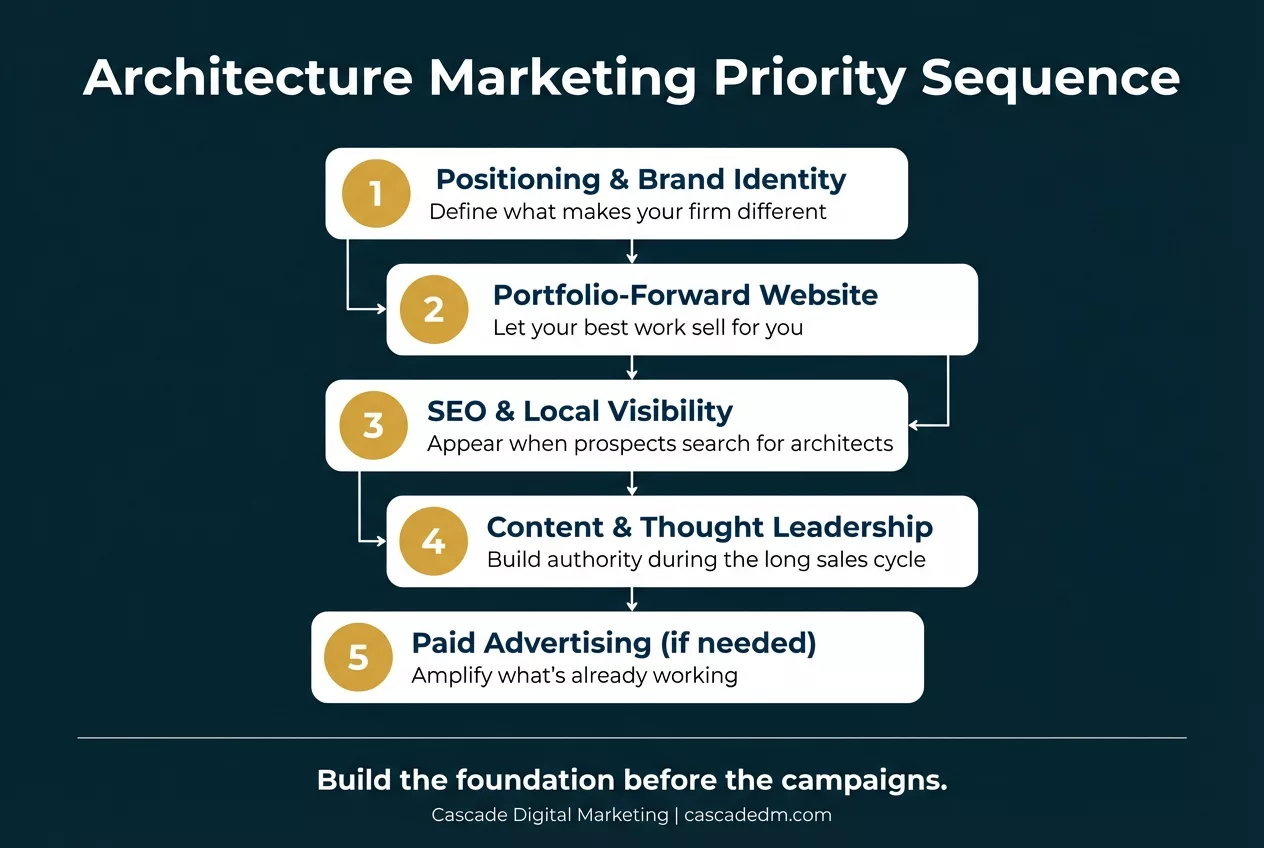
For most architecture firms, the priority sequence is: website, portfolio, SEO, content, then paid ads. Each layer builds on the one before it.
AI Search Is Changing How Architecture Clients Find Firms
Google is no longer the only place project owners research architecture firms. ChatGPT, Perplexity, Google’s AI Overviews, and other AI search tools are answering questions about architecture services directly, sometimes recommending specific firms.
When a developer asks an AI tool “best healthcare architecture firms in the Pacific Northwest,” the AI pulls from structured web content, citations, directory listings, and firm profiles to generate its answer. If your firm has no structured content online, you’re invisible in this new channel.
What this means for your architect marketing strategy:
- Structured content gets cited. AI systems favor content that directly answers specific questions with clear headings, lists, and factual statements. A page titled “Healthcare Architecture Services” with a clear description of your sector experience, notable projects, and geographic reach is far more likely to be cited than a vague “Our Services” page.
- Directory and profile consistency matters. AI systems cross-reference your firm’s information across AIA directories, your website, LinkedIn, and industry databases. Consistent firm descriptions, service listings, and project highlights across platforms increase the likelihood of being cited.
- Thought leadership builds entity authority. When your firm publishes original research or insights that get cited by other industry sources, AI systems recognize your firm as an authority. That recognition translates into mentions and recommendations in AI-generated answers.
This is still early. But the firms that build structured, authoritative content now will have a significant advantage as AI search becomes a standard part of how clients research and shortlist architecture firms.
What We’d Honestly Tell You in a First Meeting
Most marketing agencies will tell architecture firms exactly what they want to hear: “Your work speaks for itself, you just need more visibility.” That’s half true.
Here’s the full picture, including the parts that aren’t comfortable:
Marketing won’t fix a positioning problem. If your firm takes every project that comes through the door (custom residential, commercial tenant improvements, a church, a strip mall), marketing can’t create a clear identity from that. The firms that see the strongest marketing results are the ones with a defined specialty or a clearly articulated point of view about what they design and why. Before you invest in marketing, decide what you want to be known for.
Your website probably needs more work than you think. We’ve worked with award-winning firms whose websites hadn’t been updated in five years. The photography was outdated, the project list was missing three years of work, and the site didn’t load properly on mobile. No amount of SEO or content strategy compensates for a website that doesn’t represent your current work.
Architecture marketing is slow. The sales cycle for architecture projects is 6 to 18 months. That means a marketing strategy you implement today may not generate a signed contract for a year. Paid ads can accelerate awareness, and SEO can start producing traffic in 3 to 6 months. But if you need new projects next month, marketing is not the answer. You need to work your network. Marketing builds the pipeline for next year and the year after.
Not every firm needs a full marketing program. A five-person residential firm with a steady referral network and no growth ambitions doesn’t need a $5,000/month marketing retainer. They might need a better website and some project photography, then they’re set. We’d rather tell you that upfront than sell you services you don’t need.
The firms that struggle most are the ones that start and stop. Architecture marketing compounds over time. Publishing content for six months, then going dark for a year, then starting again wastes most of the momentum you built. If you can’t commit to a consistent effort for at least 12 months, the investment may not be worth it.
Frequently Asked Questions
How much should an architecture firm spend on marketing?
AIA data shows that architecture firms now invest an average of 6% of annual revenue in marketing and business development. Firms focused on custom residential work often allocate 8 to 12% because they’re acquiring clients directly. Institutional firms that rely on RFP processes typically need 4 to 6%. If your firm bills $2 million annually, a reasonable starting budget is $8,000 to $12,000 per month, covering website, SEO, content, and targeted advertising. The exact number depends on your growth goals, market competition, and how much of your pipeline you want to build outside of referrals.
Can architecture firms market without being “salesy”?
Yes, and they should. The most effective architecture marketing doesn’t look like marketing at all. It looks like showcasing excellent work, sharing insights about design, and educating potential clients about the process. Publishing a detailed case study about how you solved a complex design problem is marketing. Writing about trends in sustainable design is marketing. Having a website that clearly presents your portfolio and expertise is marketing. None of that requires a hard sell, and none of it should. Architecture clients are sophisticated buyers who respond to demonstrated competence, not sales pressure.
How long does it take for architecture marketing to produce results?
SEO and content marketing typically take 3 to 6 months to generate consistent organic traffic and 6 to 12 months to produce qualified project inquiries. Paid advertising can generate visibility within weeks, but converting that visibility into signed projects still follows the architecture sales cycle of 6 to 18 months. The most honest answer: commit to 12 months before evaluating whether marketing is “working.” Firms that measure success at 90 days almost always quit too early.
Should architecture firms use social media for marketing?
Instagram can be effective for architecture firms because the platform is visual and your work photographs well. But social media should supplement a marketing strategy, not replace one. A strong Instagram presence with no website SEO means you’re building an audience on rented land with no way to capture leads. LinkedIn is more directly useful for firms that serve commercial and institutional clients because you can connect directly with facilities managers, developers, and project owners. The priority order matters: website first, SEO second, content third, social media fourth.
Cascade Digital Marketing works with architecture firms to build digital presence, SEO strategies, and marketing systems that attract the right projects. If your firm is ready to grow beyond referrals, start a conversation.


