

By Josh Kilen
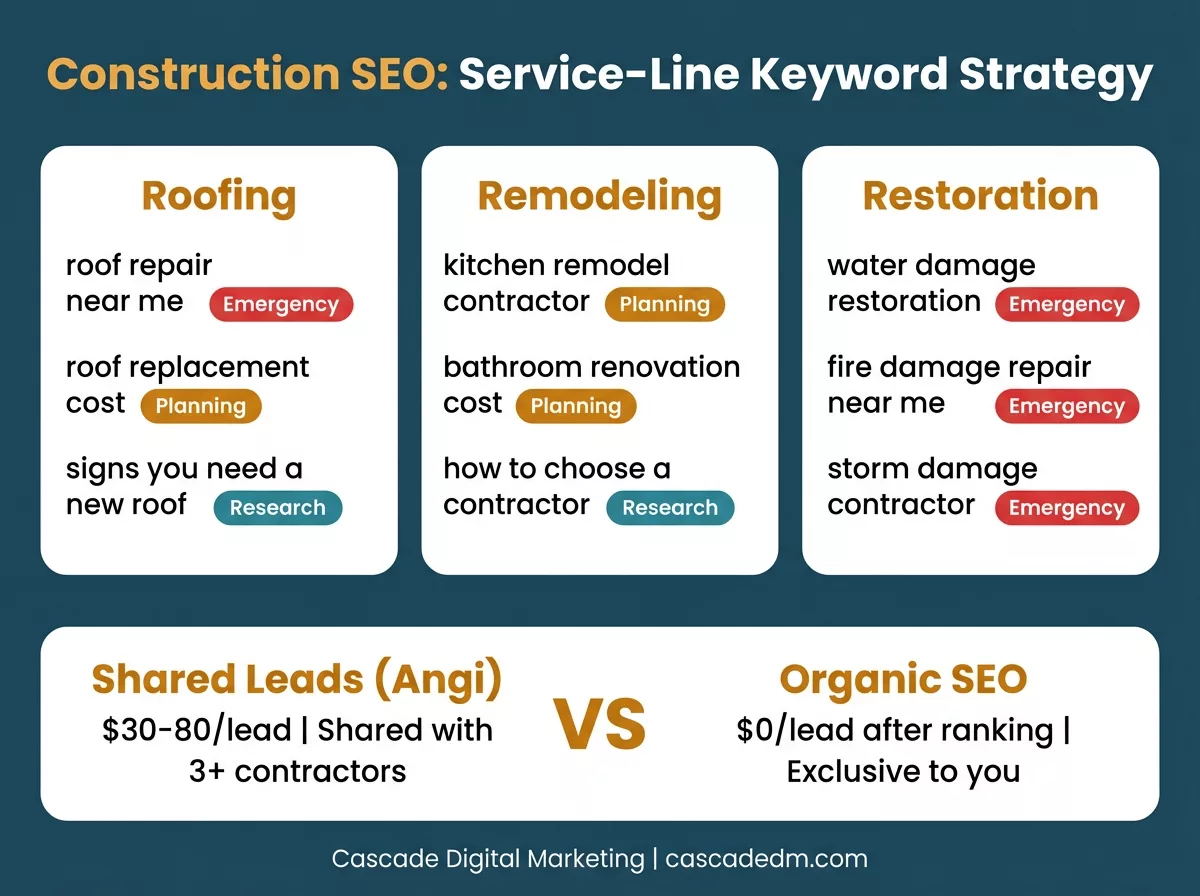
You’re paying $30 to $80 per lead on Angi. Half of them are shared with three other contractors. A quarter never pick up the phone. And the ones that do want a free estimate for a $900 job you’ll lose money on.
That’s the lead generation model most construction companies are stuck in. You’re renting access to your own customers. Every month the bill comes, and the moment you stop paying, the leads stop too. Nothing compounds. Nothing builds.
Construction company SEO is the opposite model. You build something that generates leads on its own. It takes longer to produce results than buying leads from a platform, and I’ll be honest about that timeline later in this article. But when it works, the economics aren’t even close.
We’ve run this playbook for construction companies and related trades. GTG Construction, a full-service restoration, remodeling, and roofing company, hit 5x return on ad spend after we built service-line-specific campaigns with SEO-optimized landing pages. Father Nature Landscapes, a landscape construction firm, reached 10x ROAS from a strategy rooted in homeowner search behavior research.
This guide covers how SEO for construction companies actually works. Not the generic advice you’ve read ten times already. The specific strategies for your service lines, your local market, and your actual competition, including the platforms that are eating your lunch in search results right now.
Why Construction Companies Need SEO (And Not the Reason You Think)
The obvious answer is “to get more leads.” That’s true, but it’s not the most important reason.
The real value of construction company search engine optimization is control. Right now, your lead flow is controlled by platforms that profit from making you compete with other contractors for the same homeowner. Angi, HomeAdvisor, and Thumbtack own the relationship. They own the data. And they set the price.
When your website ranks for the searches your customers are actually making, you own the relationship from the first click. No shared leads. No per-lead fees. No race to be the cheapest quote.
There’s also a compounding effect that paid leads will never match. A blog post you publish today about storm damage restoration can rank for years. A service page optimized for “kitchen remodeling [city]” generates inquiries month after month without additional spend. Paid leads are a faucet you turn on and off. SEO is a well you dig once and draw from for years.
One more thing construction company owners don’t hear often enough: your online presence affects your close rate, not just your lead volume. When a homeowner gets your name from a referral, the first thing they do is Google you. If your website looks like it was built in 2014, if you have twelve reviews and your competitor has 200, if there’s no evidence you do the specific work they need, that referral walks. A strong SEO presence strengthens every channel, including word-of-mouth.
Service-Line SEO: One Company, Multiple Keyword Strategies
This is where most contractor SEO advice falls apart. It treats a construction company like a single-service business. But if you’re running a general contracting operation with divisions in roofing, remodeling, and restoration, you’re really operating three businesses from a search perspective. The homeowner searching for “emergency roof repair” and the one searching for “whole house remodel” are different people with different problems on different timelines.
Each service line needs its own keyword strategy, its own landing pages, and often its own content.
Roofing SEO
Roofing searches are heavily local and often urgent. The keyword landscape breaks into three buckets:
- Emergency/repair: “roof leak repair [city],” “emergency roofer near me,” “storm damage roof repair.” High intent, time-sensitive. These searchers aren’t comparing three bids. They need someone today.
- Replacement: “roof replacement cost [city],” “how much does a new roof cost,” “best roofing company [city].” These are bigger decisions with longer research cycles. Cost-related content ranks well here.
- Insurance/storm: “roof insurance claim [city],” “hail damage roof inspection.” Seasonal and weather-driven. Content about the claims process builds trust with homeowners who feel overwhelmed.
A roofing page that tries to rank for all of these at once will rank for none of them. You need separate pages: an emergency repair page, a roof replacement page, a storm damage page. Each optimized for its cluster of keywords, each written for the specific person making that specific search.
Remodeling SEO
Remodeling is a high-consideration purchase. Nobody impulse-buys a $75,000 kitchen remodel. The research phase is weeks or months, which means content marketing matters more here than in almost any other construction service line.
The keywords reflect that research cycle:
- Early stage: “kitchen remodel ideas,” “bathroom remodel cost,” “how long does a home remodel take.” These are informational queries. Blog posts and guides serve them.
- Mid stage: “best remodeling companies [city],” “kitchen remodeling contractor near me.” These searchers have moved past research into comparison. Your service pages and reviews need to be strong here.
- Late stage: “remodeling estimate [city],” “remodeling company reviews [city].” They’re ready to contact someone. Your GBP and conversion-optimized landing pages close the deal.
We saw this play out with GTG Construction. Instead of building one “remodeling” page and hoping for the best, we created segmented campaigns with dedicated landing pages for each remodeling type. The result was a 5x ROAS because we were matching the right message to the right search, not asking one page to do everything.
Restoration SEO
Restoration is the most urgency-driven service line in construction. Water damage, fire damage, mold remediation. These homeowners are searching at midnight with water pouring through their ceiling. The SEO strategy has to match that reality.
Speed signals matter here more than anywhere else. Your page title should include “24/7” or “emergency.” Your meta description should mention response time. Your page content should lead with what happens when they call, not your company history.
Key keyword clusters:
- “Water damage restoration [city]”
- “Fire damage repair company near me”
- “Mold remediation [city]”
- “Emergency restoration services [city]”
For restoration, your Google Business Profile is often more important than your website. When someone searches “water damage restoration near me” on their phone, the map pack appears first. If you’re not in those top three local results, you’re invisible at the exact moment a homeowner needs you most.
Local SEO for Construction Companies
Most construction companies serve a defined geographic area. You’re not competing nationally for “kitchen remodeling.” You’re competing in your metro area, your county, and sometimes in specific neighborhoods where you want more work. That makes local SEO the highest-impact activity for most contractors.
Google Business Profile: Your Most Valuable Free Asset
Your Google Business Profile (GBP) appears in the map pack, those three local results with the map that show up before the organic listings. For local searches, the map pack gets more clicks than the #1 organic result. If you’re not optimizing your GBP, you’re giving away the most visible real estate in local search.
What actually moves the needle on GBP rankings:
- Primary category accuracy. “General Contractor” is different from “Roofing Contractor” is different from “Home Builder.” If you do multiple things, your primary category should match your highest-revenue service line. Add the others as secondary categories.
- Reviews. Specifically, recent reviews with keywords. A review that says “GTG did an amazing kitchen remodel for us in Tacoma” does more for your rankings than one that says “Great company, highly recommend.” Ask happy clients to mention the service and the city. Don’t script it word for word. Just prime them: “If you have a minute to leave a review, it really helps if you mention the type of work we did.”
- Posts and updates. Google rewards active profiles. Posting project photos, seasonal updates, or service announcements weekly signals that your business is active. This isn’t social media. It’s a ranking signal.
- Service area accuracy. List every city and neighborhood you serve. Be specific. “Tacoma” and “University Place” and “Lakewood” are three separate search markets, not one.
- Photos. Businesses with 100+ photos get 520% more calls than those with fewer than 10, according to Google’s own data. Upload before/after project photos, team photos, equipment shots, and jobsite images. Not stock photography.
Service Area Pages: The Multiplier
If you serve 15 cities, you need 15 pages. Not one page with a list of cities at the bottom. Each service area page should include:
- The city name in the title, H1, and throughout the content naturally
- Specific mentions of neighborhoods, landmarks, or local context (“serving the Proctor District, North End, and Stadium neighborhoods in Tacoma”)
- Unique content about why that market matters to your business or what types of projects you commonly do there
- Embedded Google Map showing your service area
- Local reviews from clients in that area if possible
This is tedious work. It’s also one of the fastest ways to rank in new markets. A well-built service area page targeting “roofing contractor Lakewood WA” can start pulling traffic within weeks because the competition for city-specific long-tail keywords is often minimal.
Citations and Directories
Citations are mentions of your business name, address, and phone number (NAP) on other websites. Consistency matters more than volume. If your business name is “Smith Construction LLC” on Google but “Smith Construction” on Yelp and “Smith Construction Co.” on the Better Business Bureau, search engines get confused and your local rankings suffer.
The directories that matter most for construction companies:
- Google Business Profile (non-negotiable)
- Yelp
- BBB (Better Business Bureau)
- Houzz (especially for remodeling and design-build)
- Angi/HomeAdvisor (yes, even if you hate paying for their leads, the citation value and reviews matter)
- Industry-specific: NAHB directory, state contractor licensing board, local builders association
Get your NAP consistent across all of them. Then stop worrying about directories and focus on the strategies that actually move rankings.
Content That Ranks for Construction Searches
Here’s what homeowners actually Google before hiring a contractor. Not what you think they search for. What the data shows.
The top-performing content categories for construction company websites:
Cost Content
“How much does a [service] cost in [city]?” is one of the highest-volume search patterns in home services. Most contractors avoid publishing pricing content because “every project is different.” That’s true. It’s also why the contractors who DO publish pricing ranges dominate search results for these queries.
You don’t need to publish an exact price list. You need a page that says: “A kitchen remodel in Tacoma typically costs between $35,000 and $120,000 depending on scope, materials, and layout changes. Here’s what drives that range.” Then break down the variables honestly.
This content builds trust with homeowners and pre-qualifies leads. Someone who reads your cost page and still calls is a more educated, more serious prospect than someone clicking a shared lead from Angi.
Process Content
“What to expect during a [service]” and “how long does [service] take” content performs well because homeowners are anxious about construction projects disrupting their lives. A detailed timeline of what happens during a kitchen remodel, from design to demolition to completion, answers real questions and positions you as the transparent option.
Comparison Content
“[Service A] vs. [Service B]” posts capture searchers in the decision phase. “Asphalt vs. metal roof cost comparison,” “full kitchen remodel vs. cabinet refacing,” “repair vs. replace: when to get a new roof.” These are high-intent queries where the searcher is actively choosing between options. Being the company that helps them decide is a strong position.
Seasonal Content
Construction is seasonal, and your content strategy should reflect that. Publishing “How to prepare your roof for winter in the Pacific Northwest” in September captures searches that peak in October and November. “Spring remodeling: best time to start your kitchen project” targets the research phase that precedes the busy season.
Plan your content calendar around your seasonal workflow. Publish 4-6 weeks before the demand spike so pages have time to index and rank.
Technical SEO Basics for Contractor Websites
You don’t need to become an SEO expert to get the technical foundations right. But getting them wrong can sabotage everything else you do. Here are the non-negotiable technical elements for construction company websites.
Page Speed
Construction company websites are often image-heavy, which makes them slow. Google uses page speed as a ranking factor, and homeowners on mobile will leave a site that takes more than three seconds to load.
Fix the big problems first:
- Compress all images. A 4MB project photo should be under 200KB on your website. Use WebP format.
- Use lazy loading so images below the fold don’t load until the user scrolls to them.
- If your site is on a cheap shared hosting plan, move it. The $10/month you’re saving costs you thousands in lost leads from slow page loads.
Mobile Experience
Over 60% of home service searches happen on mobile. Your website has to work on a phone, not just technically function, but be genuinely easy to use. Phone numbers should be tappable. Forms should be short (name, phone, brief description of project). Navigation should be simple.
Load your website on your phone right now. If you have to pinch-zoom to read text or if the contact form is buried three scrolls down, you have a problem.
Schema Markup
Schema markup tells search engines what your content means, not just what it says. For construction companies, the most valuable schema types are:
- LocalBusiness (or more specific: GeneralContractor, RoofingContractor, HomeAndConstructionBusiness). This feeds your business info directly to Google’s knowledge panel.
- Review/AggregateRating. This can display star ratings in search results, boosting click-through rates.
- FAQPage. FAQ schema can earn expanded search results with dropdown answers, taking up more real estate on the results page.
- Service. Markup each service you offer so search engines understand the relationship between your business and your service lines.
You don’t have to implement schema yourself. Any competent web developer can add it in a few hours, and it produces outsized results relative to the effort.
Competing Against Lead Gen Platforms in Search Results
Search for “roofing contractor [any city]” and count how many organic results are actual contractors versus platforms. You’ll typically see Angi, HomeAdvisor, Thumbtack, Yelp, and sometimes Houzz taking up half or more of the first page. These platforms spend millions on SEO. You’re not going to outrank them with a $50/month blog.
But you don’t have to beat them everywhere. You have to beat them where it matters.
Where You Can Win
Long-tail, service-specific keywords. Platforms optimize for broad terms like “contractors near me.” They’re weaker on specific queries like “whole house remodel contractor Tacoma” or “commercial roof repair Pierce County.” The more specific the search, the more likely a local contractor’s website can rank above the platforms.
Branded and reputation queries. When someone searches your company name, your website should own the entire first page. That means your site, your GBP, your social profiles, and your directory listings should all appear. If an Angi profile outranks your own website for your company name, your website needs work.
“Near me” with strong GBP. The local map pack sits above organic results, and platforms don’t appear in the map pack. Only businesses with physical or service-area presence do. Winning the map pack means you appear before Angi, before HomeAdvisor, before every platform.
Where You Should Stop Fighting
Head terms like “contractors near me” or “construction company.” The platforms have too much domain authority. Trying to rank organically for these terms is burning time and money. Use them in your Google Ads strategy instead, and focus your SEO effort on the long-tail terms you can actually win.
The Indirect Strategy
Here’s something most SEO guides won’t tell you: you can use the platforms against themselves. Maintain complete, optimized profiles on Angi, HomeAdvisor, and Houzz, not for the leads (or not primarily), but for the backlinks and citations. A link from Angi to your website is a relevant, high-authority backlink. An optimized Houzz profile with project photos ranks for design-related searches and sends traffic to your site. Use the platforms strategically without depending on them for lead flow.
The Damaging Admission: What SEO Can’t Do for Your Construction Company
I’d be doing you a disservice if I didn’t say this clearly: SEO is not fast.
If you need leads next month, SEO isn’t your answer. Google Ads or even Angi leads will get you there faster. SEO is a 6-to-12-month play for most construction companies, and anyone who tells you otherwise is either lying or doesn’t understand the timeline.
Here’s a realistic timeline for a construction company starting contractor SEO from scratch:
- Months 1-2: Technical fixes, on-page optimization, GBP optimization, content planning. You’ll see minimal traffic changes.
- Months 3-4: New content starts indexing. You might see movement for low-competition, long-tail keywords. Leads are still trickling.
- Months 5-8: Content gains traction. Local rankings improve. GBP starts appearing in map pack for target keywords. Leads increase, but not dramatically.
- Months 9-12: Compounding kicks in. Established content ranks for more keywords. Backlink profile strengthens. Lead volume becomes meaningful and consistent.
That’s assuming the work is being done correctly and consistently. Publish one blog post and wait isn’t a strategy. Neither is setting up your GBP once and never touching it again.
There are also problems SEO can’t fix:
- A 3.2-star Google rating. No amount of traffic matters if your reviews are bad. We’ve told clients to pause campaigns and fix their review profile before spending another dollar on marketing. It’s not a popular recommendation. It’s the right one.
- A broken sales process. If your phone goes to voicemail during business hours, if you take five days to send an estimate, if your follow-up is nonexistent, SEO will send you leads that you waste. Fix your intake process first.
- Unrealistic expectations. If you expect SEO to match the volume of paid leads in 90 days, you’ll pull the plug on a strategy that was working but just needed more time. The compounding effect of SEO is its greatest strength, but it requires patience that many construction company owners, understandably, struggle with.
The best approach for most construction companies is to run paid campaigns (Google Ads, Meta) for immediate lead flow while building SEO for long-term, lower-cost leads. That’s exactly what we did with GTG Construction: paid campaigns for short-term results, SEO and content for the foundation that reduces cost per lead over time.
Building Your Construction SEO Strategy: Where to Start
If you’ve read this far, you have a framework. Here’s how to prioritize:
Month 1: Foundation
- Claim and fully optimize your Google Business Profile
- Fix your NAP consistency across top directories
- Ensure your website is mobile-friendly and loads in under 3 seconds
- Add schema markup (LocalBusiness at minimum)
- Create dedicated pages for each service line (don’t cram everything onto one “Services” page)
Months 2-3: Local Expansion
- Build service area pages for every city you serve
- Launch a review generation system (ask every completed project for a review, make it easy with a direct link)
- Publish your first 4-6 pieces of content targeting cost and process questions for your highest-revenue service line
Months 4-6: Content Acceleration
- Expand content to cover all service lines
- Target comparison and seasonal keywords
- Start building backlinks through local partnerships, supplier relationships, and industry associations
- Monitor rankings and adjust based on what’s gaining traction
Ongoing: Compound and Maintain
- Publish 2-4 pieces of optimized content per month
- Update existing content quarterly (refresh data, add new project photos, update pricing ranges)
- Respond to every Google review within 48 hours
- Track leads by source so you can measure SEO’s contribution to revenue, not just traffic
FAQ
How long does SEO take to work for a construction company?
Plan for 6-12 months before SEO becomes a meaningful lead source. Local SEO improvements (GBP, map pack) tend to show results faster, sometimes in 3-4 months. Organic rankings for competitive service keywords take longer. The timeline depends on your starting point, your market’s competitiveness, and how consistently you invest in content and optimization.
How much does construction company SEO cost?
Legitimate construction SEO services typically cost $1,500 to $5,000 per month depending on the scope. That includes technical optimization, content production, local SEO management, and reporting. Be wary of agencies offering “full SEO” for $500/month. At that price, you’re getting automated reports and minimal actual work. The right question isn’t “how much does it cost” but “what’s the cost per lead compared to my alternatives?” If Angi charges you $50 per shared lead and SEO generates exclusive leads at $25 each after month eight, the investment math is straightforward.
Should I do SEO myself or hire an agency?
Some pieces you can handle in-house. GBP management, review generation, and basic content publishing are learnable skills. Technical SEO, keyword research, competitive analysis, and strategic content planning typically require specialized expertise. The risk of DIY isn’t that you’ll break something. It’s that you’ll spend six months doing low-impact work and conclude that “SEO doesn’t work for construction companies” when really the strategy was wrong. If you’re going to invest the time, invest in learning what to prioritize. If you’d rather focus on running your business, work with an agency that understands your industry.
Can SEO replace paid advertising for my construction company?
Eventually, partially. SEO can become your largest and lowest-cost lead source, but it rarely replaces paid entirely. Paid advertising gives you control over volume. Need more leads this month? Increase the budget. SEO doesn’t offer that dial. The smartest construction companies run both: paid for immediate, controllable lead flow, and SEO for the long-term pipeline that gets cheaper every month. Over time, as SEO matures, you may shift budget away from paid, but eliminating it entirely means giving up the ability to scale lead volume on demand.
Cascade Digital Marketing builds research-driven marketing strategies for construction companies. If you’re tired of renting leads and ready to build a pipeline you actually own, let’s talk.


