

By Josh Kilen
Search for “law firm marketing strategy” and you’ll find the same article written 50 different ways. Create an executive summary. Define your target audience. Optimize your Google Business Profile. These aren’t strategies. They’re checklists. And they’re the reason most law firms burn through $5,000 a month on marketing with nothing to show for it.
Here’s what those articles won’t tell you: a family law firm and an estate planning firm need completely different marketing strategies. The channels, the timelines, the budgets, the messaging, the compliance considerations. All different. A criminal defense attorney buying the same Google Ads package as a trusts and estates lawyer is wasting money by design.
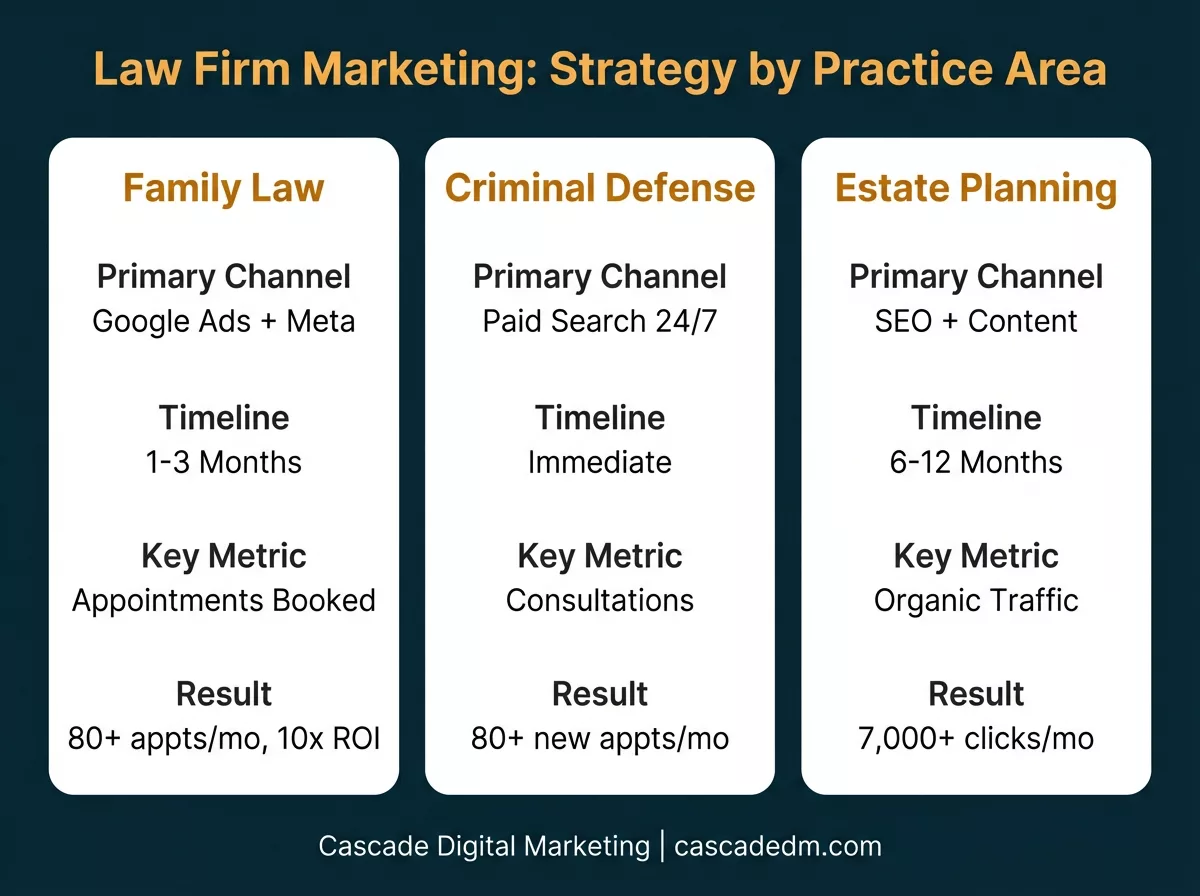
We’ve built marketing strategies for law firms across practice areas. The results aren’t theoretical. Dumm Law (estate planning) went from a handful of organic visitors to 7,000+ clicks per month. Torrone Law (family law) generates 80+ appointments per month at a 10x return on ad spend. Jordan Foster Law (criminal defense) books 80+ new appointments per month from digital channels alone. Those numbers came from practice-area-specific strategies, not from following a generic template.
This guide covers what a real law firm marketing strategy looks like when it’s built on research, tailored to your practice area, and accountable to revenue.
Why Most Law Firm Marketing Plans Fail Before They Start
Every marketing plan template starts the same way. Write a mission statement. Identify your target audience. Set SMART goals. Allocate 2-7% of revenue to marketing. Then pick some tactics and hope for the best.
The problem isn’t any single piece of that advice. The problem is that none of it forces you to make hard decisions. When everything is a priority, nothing is. And when your “strategy” is a list of 15 tactics you found on a blog, you end up spreading your budget so thin that no single channel gets enough investment to actually work.
We see this constantly. A firm spends $1,500 on Google Ads, $800 on social media management, $600 on blog content, $400 on email marketing, and $200 on directory listings. That’s $3,500 per month doing five things poorly instead of two things well.
The firms we’ve watched succeed share three traits. They picked a primary channel and funded it properly. They chose that channel based on their practice area and how their specific clients actually search for help. And they gave the strategy enough time to compound before pulling the plug or pivoting.
Everything in this article builds on that foundation: specificity over breadth, research over assumptions, and patience over panic.
Your Practice Area Changes Everything About Your Marketing Strategy
This is where every competitor article falls short. They treat “law firm” as a monolith. But a person searching for a divorce attorney at 11 PM on a Tuesday is in a completely different mental state than someone Googling “do I need a living trust” on a Saturday morning. Your marketing strategy has to match the buyer, and the buyer depends on the practice area.
Family Law Marketing Strategy
Family law clients are making emotional, often urgent decisions. They’re searching during moments of crisis: after a fight, after being served papers, after discovering something that changes everything. They need to feel heard before they need to feel impressed by credentials.
What works: Google Ads targeting high-intent keywords (“divorce lawyer near me,” “child custody attorney [city]”) captures people at the moment of need. Meta ads build awareness and retargeting keeps your firm visible during the weeks-long decision process between “I need a lawyer” and “I’m hiring this one.” Reviews and testimonials carry enormous weight because family law clients need to trust you with the most personal details of their lives.
Case study: We built a practice-area-specific strategy for Torrone Law that combined Google Ads for high-intent capture with Meta campaigns for awareness and retargeting. The result: 80+ appointments per month at a 10x return on ad spend (ROAS). That didn’t come from running generic ads. It came from messaging that matched the emotional state of someone searching for a family law attorney and landing pages built to convert that specific person.
Criminal Defense Marketing Strategy
Criminal defense is the most time-sensitive practice area in legal marketing. When someone gets arrested at 2 AM, they’re searching for a lawyer on their phone from the back of a police car or a holding cell. Speed, availability, and mobile experience aren’t nice-to-haves. They’re the entire strategy.
What works: Google Search Ads and Local Service Ads dominate here. The searcher has extreme intent and near-zero patience. Your Google Business Profile needs to signal 24/7 availability. Your website needs to load in under two seconds on mobile and put a phone number front and center. Long-form content and social media matter far less in criminal defense than in almost any other practice area.
Case study: Jordan Foster Law invested in a criminal defense marketing strategy focused on paid search, mobile optimization, and rapid intake. The result: 80+ new appointments per month from digital channels. The key wasn’t spending more. It was spending on the right channel (paid search) with messaging built for someone who needs a lawyer right now, not next week.
Estate Planning Marketing Strategy
Estate planning sits at the opposite end of the urgency spectrum. Clients aren’t in crisis. They’re planning. They’re researching. They might spend months reading articles about trusts, wills, and asset protection before they ever pick up the phone. This means your strategy has to educate first and sell second.
What works: Content marketing and SEO are the primary drivers. Blog posts, guides, and educational resources that rank for informational keywords (“how does a revocable trust work,” “estate planning checklist”) build authority over months and years. Email nurture sequences keep your firm top-of-mind during the long decision cycle. Paid ads work best as retargeting to people who’ve already engaged with your content, not as cold acquisition.
Case study: Dumm Law’s estate planning practice invested in a content-first strategy targeting dozens of long-tail keywords. Over 18 months, organic traffic grew to 7,000+ clicks per month. That traffic now generates a steady pipeline of consultations without ongoing ad spend. The timeline matters here. If Dumm Law had expected results in 90 days, they would have abandoned the strategy that eventually became their most cost-effective client acquisition channel.
Start With Research, Not Tactics
Most marketing advice jumps straight to tactics. Run Google Ads. Post on social media. Start a blog. But tactics without research is just spending money faster.
Research means understanding three things before you spend a dollar on marketing:
- What your potential clients actually search for. Not what you think they search for. Actual keyword data, with search volume and competition metrics. “Estate planning attorney” and “do I need a trust” attract completely different people at completely different stages of the buying process.
- What your competitors are doing (and where the gaps are). If every estate planning firm in your market is running Google Ads for the same five keywords, the cost per click is astronomical and the margins are thin. But if none of them have invested in content marketing, there’s an open lane.
- How your ideal clients make decisions. A corporate client choosing outside counsel runs a formal RFP process. A person facing DUI charges makes a decision in hours. Your marketing strategy has to match the actual decision-making process, not an imagined one.
The “spend 2-7% of revenue on marketing” advice is useless without this context. Two percent of revenue allocated to the right channel with the right messaging outperforms seven percent scattered across everything. Research is what tells you where to concentrate.
Choosing the Right Marketing Channels for Your Firm
Not every channel works for every firm. This is the most expensive lesson in legal marketing, and most firms learn it by wasting money first.
Google Ads (Search)
Google Search Ads put your firm in front of people who are actively looking for a lawyer right now. That makes it the highest-intent channel available. It’s also the most expensive. Average cost-per-click for legal keywords ranges from $50 to $150+ for competitive terms like “personal injury lawyer” or “criminal defense attorney.” In major metros, it can run higher.
Google Ads work best for practice areas with high urgency and clear commercial intent: criminal defense, personal injury, family law. They work less well for practice areas where clients research for months before hiring, like estate planning or business law.
The critical mistake firms make with Google Ads isn’t spending too much. It’s spending without proper conversion tracking. If you can’t trace a click through to a signed client, you’re guessing at ROI.
SEO and Content Marketing
Search engine optimization is a long game. It takes 6-18 months to build meaningful organic traffic, depending on your market’s competitiveness. But the economics are different from paid ads. Once a page ranks, it generates traffic without ongoing cost per click.
Dumm Law’s organic growth to 7,000+ clicks per month took 18 months of consistent content marketing: publishing educational articles, building internal linking structures, and earning topical authority in estate planning. Today, that organic traffic generates consultations at a fraction of what paid ads would cost for the same volume.
Content marketing works best for practice areas with long decision cycles and informational search behavior. Estate planning, business law, intellectual property, and employment law all benefit from this approach.
Digital Advertising (Meta/Facebook)
Meta ads are not a direct-response channel for most law firms. Nobody scrolls Facebook looking for a lawyer. But Meta excels at two things: building awareness in a geographic area and retargeting people who’ve already visited your website or engaged with your content.
For family law and personal injury, Meta awareness campaigns can be highly effective because the audience is broad (almost anyone could need a divorce attorney or be in a car accident). For niche practice areas like mergers and acquisitions or patent law, Meta is usually a waste of budget. Understanding where digital advertising fits in your specific strategy prevents the most common overspend we see.
Other Channels Worth Considering
Email marketing works best as a nurture tool for longer sales cycles. Estate planning and business law firms that build email lists from content downloads can nurture leads for months until they’re ready to hire.
Online reviews matter for every practice area but are especially critical for family law and criminal defense, where trust is the primary buying factor.
Referral networks remain the highest-converting lead source for most law firms. A marketing strategy should support and amplify referrals, not replace them.
Bar Advertising Rules Will Shape Your Entire Strategy
Here’s something missing from almost every “law firm marketing strategy” article online: state bar advertising rules can determine what you’re allowed to say, where you’re allowed to say it, and how you say it.
Every state bar has advertising rules. They vary significantly. Some states require pre-approval of advertising materials. Others require specific disclaimers on every ad. Most prohibit guaranteeing outcomes, claiming specialization without board certification, or using testimonials in misleading ways.
Common violations that get firms in trouble:
- Calling yourself a “specialist” or “expert” without board certification in states that restrict those terms
- Client testimonials that imply guaranteed results (“My attorney got me $500,000” without disclaimers)
- Using the word “free” for consultations without disclosing conditions
- Omitting required disclaimers about past results not guaranteeing future outcomes
This matters for your marketing strategy because it shapes everything from ad copy to website content to social media posts. If your marketing agency doesn’t understand bar advertising rules for your state, they’re a liability. Ask your agency what bar advertising rules they’ve reviewed before writing a single ad. If they look confused, that’s your answer.
The safe approach: have your state bar’s advertising rules reviewed by someone at your firm before launching any campaign, and build compliance review into your ongoing marketing process. It’s slower, but it protects your license.
AI Search Is Changing How Clients Find Law Firms
Google is no longer the only place potential clients research law firms. ChatGPT, Perplexity, Google’s AI Overviews, and other AI search tools are answering legal questions directly, often without the user ever clicking through to a website.
This changes the marketing equation. If an AI tool answers “do I need a trust in Washington state” with a complete summary, the user may never visit your estate planning blog post that targets that keyword. Your organic traffic for informational queries could decline even as your content quality stays the same.
What this means for your law firm marketing strategy:
- Structured content matters more than ever. AI systems pull from content that’s clearly organized with headings, lists, and direct answers to specific questions. Vague, fluffy content gets ignored.
- Entity authority is the new domain authority. AI systems recommend firms and attorneys they recognize as authoritative on a topic. Building entity relationships (citations in directories, mentions in publications, consistent NAP data) helps AI tools identify your firm as a credible source.
- Bottom-of-funnel content becomes more valuable. Informational content may lose traffic to AI answers, but high-intent content (“best divorce attorney in [city],” “estate planning consultation near me”) still drives clicks because users want to take action, not just get answers.
Law firms that adapt their marketing strategy to account for AI search will have an advantage as this shift accelerates. Those that ignore it will wonder why their organic traffic is declining despite doing “everything right.” When we audited 509 estate planning firms, four in five were invisible to AI search — not ranked lower, but absent from the answer entirely. The firms that fix it first, in markets where almost no one has, get to define how their whole region gets found.
What We’d Tell You If You Hired Us Tomorrow
Most marketing agencies tell you what you want to hear. Everything works, results come fast, just increase your budget. Here’s what we’d actually tell you.
Marketing takes 6 to 12 months to produce consistent results. Paid ads can generate leads in weeks, but building a sustainable, multi-channel marketing system that reduces your cost per acquisition over time takes at least six months. If someone promises you’ll dominate your market in 90 days, they’re either lying or they don’t understand legal marketing.
A real law firm marketing strategy costs $3,000 to $8,000 per month. That includes strategy, ad spend, content production, and ongoing optimization. You can spend less, but you’ll be doing fewer things and growing slower. You can spend more, but only after the foundation is working and you have data to guide where the extra budget goes. The firms we’ve seen waste the most money are the ones that jumped to a $10,000/month budget before they had conversion tracking in place.
Some firms aren’t ready for marketing. If your intake process loses half the leads that come in, spending more on marketing just means losing more leads faster. If your Google reviews average 3 stars, sending more traffic to your profile makes the problem more visible. If your website takes 8 seconds to load on mobile, your paid ads are paying for bounces. Sometimes the right marketing advice is: fix your operations first.
Not every channel will work for your firm. We’d rather tell you to stop spending on a channel that isn’t converting than keep collecting a management fee on it. That’s how we think about our client relationships, and it’s how you should evaluate any agency you work with.
We don’t say this to be self-deprecating. We say it because the firms that succeed are the ones that start with realistic expectations, invest in the right foundations, and give the strategy time to work.
A Realistic Timeline for Your Law Firm Marketing Strategy
Here’s what a responsible implementation looks like, assuming you’re starting from a reasonable baseline (existing website, some online presence, functional intake process):
Months 1-2: Research and Foundation
- Competitive analysis and keyword research for your practice area and market
- Website audit (speed, mobile experience, conversion paths, compliance review)
- Analytics and conversion tracking setup (so you can measure everything that follows)
- Intake process review to make sure leads don’t leak
Months 3-4: Channel Launch
- Primary channel goes live (paid search, content program, or both, depending on practice area)
- Landing pages built for each practice area with proper tracking
- Review generation process starts
- Initial data collection and baseline metrics
Months 5-6: Optimization
- First round of data-driven adjustments (ad copy, targeting, bid strategy)
- Secondary channels added if primary channel is performing
- Content begins to index and gain organic traction
- Cost per lead and cost per acquisition become measurable
Months 7-12: Compounding
- Organic traffic builds on itself as content library grows
- Paid campaigns get more efficient as data accumulates
- Retargeting audiences grow, reducing cost per acquisition
- You have enough data to make real strategic decisions about scaling
The firms that follow this timeline and resist the urge to panic at month three are the ones generating 80+ appointments per month by month twelve. The ones that switch agencies every six months never get past the foundation stage.
Frequently Asked Questions
How much should a law firm spend on marketing?
There’s no universal number, despite what every article telling you “7-10% of revenue” suggests. The right budget depends on your practice area, market competitiveness, and growth goals. A solo family law attorney in a mid-size city might generate strong results at $3,000-4,000 per month. A multi-attorney personal injury firm in a major metro might need $15,000+ to compete on paid search alone. Start with what you can sustain for 12 months, allocate it to one or two channels based on research, and scale based on measured performance.
How long does it take for law firm marketing to work?
Paid search ads can generate leads within the first two weeks. But building a marketing strategy that consistently delivers qualified appointments at a sustainable cost takes 6-12 months. SEO and content marketing take the longest to show results (12-18 months for competitive markets) but also deliver the lowest long-term cost per acquisition. The biggest mistake is evaluating a strategy after 60 days when the real returns come after 6 months.
Should law firms do marketing in-house or hire an agency?
It depends on your firm’s size and growth goals. In-house works if you have someone with real marketing expertise (not a paralegal who also manages the website) and you’re willing to invest in the tools and training they need. An agency makes sense when you need access to specialists across multiple channels (SEO, paid search, content, analytics) without hiring four full-time employees. The worst option is hiring a generalist agency that doesn’t understand legal marketing, bar advertising rules, or how law firm clients actually make hiring decisions.
What’s the best marketing channel for law firms?
There isn’t one. The best channel depends entirely on your practice area. Criminal defense firms should prioritize Google Search Ads and Local Service Ads because their clients need a lawyer immediately. Estate planning firms should invest in SEO and content marketing because their clients research for months. Family law firms often benefit from a combination of paid search for high-intent capture and Meta ads for awareness and retargeting. The right answer comes from matching the channel to how your specific clients search for and evaluate legal help.
Build a Strategy That Fits Your Firm
A law firm marketing strategy built on research, tailored to your practice area, and measured against real business outcomes will outperform a generic plan every time. The difference between the firms generating 80+ appointments per month and the ones struggling to fill their calendar usually isn’t budget. It’s strategy.
If you’re ready to build a marketing strategy based on how your clients actually find and hire attorneys, not a recycled template, we should talk. We’ll start with research into your market, your competitors, and your practice area, and build a plan based on what the data says will work. No fluff. No 15-tactic checklists. Just a strategy designed to drive signed clients.


