

By Josh Kilen
Nobody wakes up at 2 AM panicking about their estate plan. Nobody Googles “estate planning attorney near me” from a hospital waiting room. Nobody calls three firms on a Monday morning because they got served papers over the weekend.
That’s criminal defense. That’s family law. Estate planning is the opposite of both.
Estate planning clients move slowly. They read an article about living trusts over coffee. They bookmark it. Three weeks later, they search “what happens if I die without a will.” A month after that, they ask a friend if they have a trust. Six months in, they download a checklist. Somewhere between month 8 and month 14, they finally pick up the phone.
Every one of those searches now runs through Google’s AI Overviews and ChatGPT first. When we audited 509 estate planning firms across 30 markets, four in five were invisible to those tools — and a firm an AI can’t see is a firm it can’t recommend during the very months a prospect is deciding.
This timeline changes everything about how you market. The tactics that fill a criminal defense attorney’s calendar (Google Ads, Local Service Ads, “call now” landing pages) will burn your budget. Your prospective clients aren’t ready to buy. They’re ready to learn.
Estate planning marketing that actually works starts with education, earns trust over months, and converts when the client decides they’re ready. Not when you decide they should be.
This guide breaks down the strategy we used to take an estate planning firm from a handful of organic visitors to over 7,000 organic clicks per month, without relying on paid ads.
The Fundamental Problem: Zero Urgency
Every marketing channel works differently depending on how urgent the buyer’s need is. Criminal defense? Maximum urgency. The client needs a lawyer today. Family law? High urgency. The client needs a lawyer this week. Estate planning? Almost no urgency at all. The client needs a lawyer… eventually.
This isn’t a minor difference. It rewrites the entire playbook.
When urgency is high, paid ads print money. A person searching “DUI lawyer near me” at midnight has a credit card out and a phone ready. Conversion rates run 15-25%. The math works.
When urgency is low, that math collapses. A person searching “do I need a living trust” isn’t hiring anyone today. If you spend $15-30 per click sending them to a consultation booking page, your conversion rate will be 1-3%. You’ll spend $1,000 to get one phone call from someone who might not be ready for six months.
This is why so many estate planning firms get frustrated with marketing. They hire an agency that runs the same playbook they’d run for personal injury or family law. Google Ads. Landing pages. Call tracking. The agency reports “impressions” and “clicks.” But signed engagements don’t materialize.
The problem isn’t the firm. It’s the strategy.
Content Marketing Is the Engine
If paid ads are the wrong primary channel, what’s the right one? The best marketing for estate planning attorneys is content marketing backed by search engine optimization. Not because it’s trendy. Because it matches how your clients actually behave.
Think about the searches your ideal client makes in the 6-18 months before they call you:
- “What happens if I die without a will in [state]?”
- “Revocable trust vs irrevocable trust”
- “Estate planning checklist”
- “Do I need a living trust?”
- “How to avoid probate”
- “What is a power of attorney?”
- “How much does estate planning cost?”
- “Asset protection for small business owners”
These are informational queries. The person searching isn’t looking for an attorney. They’re looking for answers. And the firm that provides those answers, clearly and without a hard sell, becomes the firm they trust when they’re finally ready to hire someone.
This is exactly how we built the strategy for Dumm Law, an estate planning firm with three offices across Missouri and Arkansas. When we started working together, the firm’s website (protectingwealth.com) had minimal organic visibility. Solid credentials, decades of experience, five state bar admissions. But almost no one could find them through Google.
We built a content strategy targeting the exact informational keywords their prospective clients were searching. Not “estate planning attorney Joplin” (a keyword with tiny volume and high competition from directories). Instead: “what is a revocable living trust,” “how to protect assets from nursing home costs,” “estate planning for business owners,” and dozens of similar long-tail queries where real people were asking real questions.
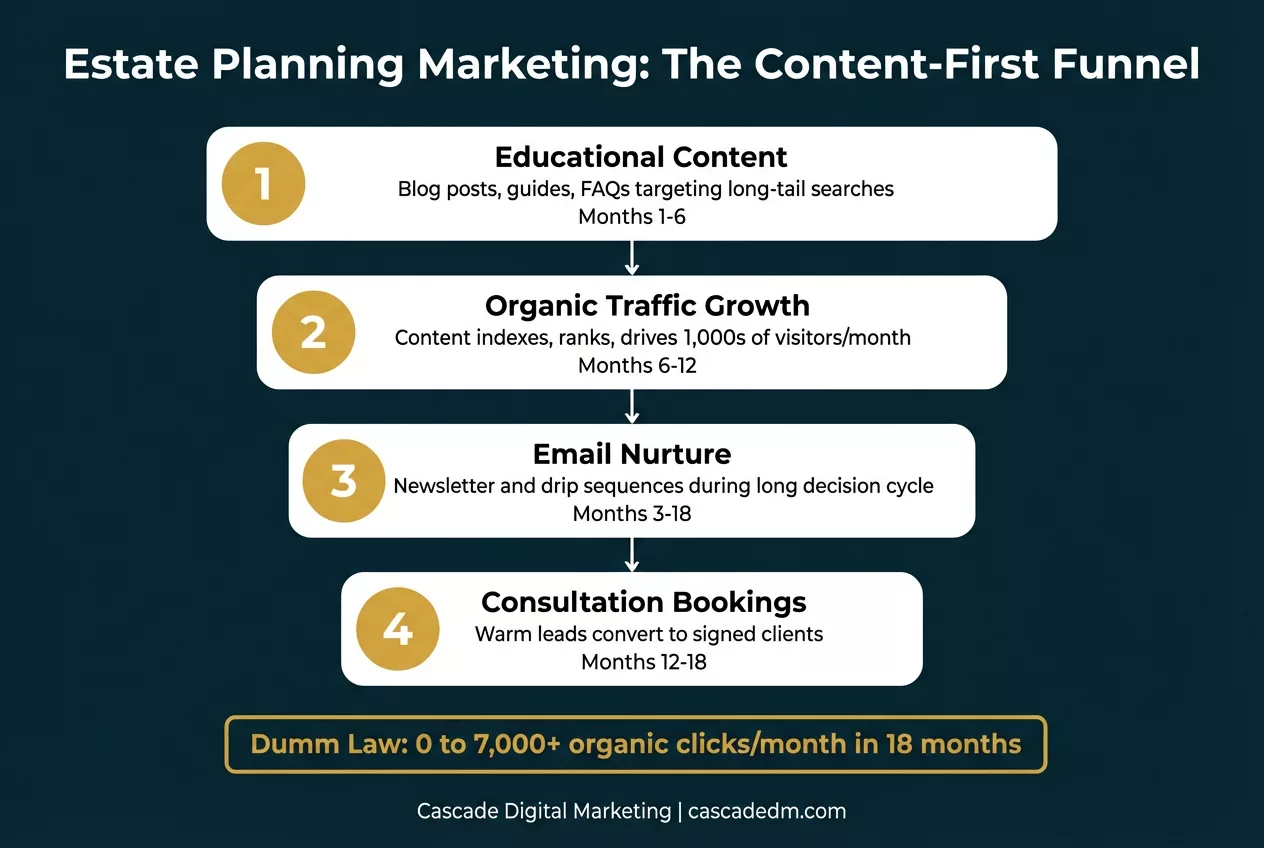
The results over 18 months: from near-zero organic traffic to over 7,000 organic clicks per month. That’s 7,000 people finding the firm through educational content every month, without a dollar spent on ads to get them there.
Here’s what that content strategy looked like in practice:
Educational blog posts answering specific questions. Each post targeted one primary keyword, answered the question directly, and linked to the relevant service page. No fluff. No 300-word summaries. Detailed, authoritative answers that gave the reader enough information to understand the concept and enough reason to want professional help implementing it.
Service pages built around practice areas. Separate pages for wills, trusts, probate, asset protection, Medicaid planning, special needs planning, and business succession. Each page written for the person researching that topic, not for other attorneys. Clear explanations of what the service involves, who needs it, and what the process looks like.
Internal linking between educational and commercial content. A blog post about “how to avoid probate in Missouri” links to the firm’s probate services page. A post about “revocable vs irrevocable trusts” links to the trusts service page. This structure passes authority from high-traffic educational content to the pages that actually generate consultations.
Consistent publishing schedule. Not three posts the first month and then nothing for six months. Steady, consistent output: 4-8 posts per month, every month, for 18 months. Content marketing compounds. Month 1 looks like nothing. Month 6 looks like a trickle. Month 12 looks like a stream. Month 18 looks like a river.
Keyword Strategy: Think Like a Client, Not a Lawyer
The biggest mistake estate planning firms make with SEO is targeting keywords the way a lawyer thinks about them. You think in terms like “estate planning,” “testamentary trust,” “irrevocable life insurance trust,” and “pour-over will.” Your clients think in terms like “what happens to my house when I die” and “how to keep the government from taking my money.”
The gap between attorney language and client language is where most estate planning attorney marketing strategies fail. You optimize for the words you use. Your clients search for the words they use. And those are different words.
Here’s how keyword strategy should work for an estate planning firm:
Start with questions, not terms. Use Google’s “People Also Ask” boxes, Answer The Public, and actual client intake conversations to build a list of questions your prospective clients are asking. These questions become your content calendar.
Target long-tail keywords first. “Estate planning” has a keyword difficulty of 60+ and is dominated by national brands and legal directories. You won’t outrank them. “How much does estate planning cost in Missouri” has a fraction of the volume but almost zero competition, and the person searching it is far more likely to become your client.
Group keywords by topic clusters. Create a pillar page for each major practice area (trusts, wills, probate, asset protection) and surround it with blog posts targeting related long-tail keywords. This cluster structure tells Google that your site is an authority on the topic, which lifts rankings across the entire cluster.
Don’t ignore local modifiers. “Estate planning attorney Springfield MO” isn’t a high-volume keyword, but it carries enormous intent. Someone searching that phrase is looking for a firm in your city. Make sure your service pages include geographic terms naturally, not stuffed in awkwardly, but present.
Monitor what’s actually ranking. Check Google Search Console monthly. You’ll discover keywords you never thought to target. Some of the highest-performing pages for Dumm Law ranked for queries we didn’t explicitly target because the comprehensive content naturally answered adjacent questions.
The Long Sales Cycle and Why Email Changes Everything
A visitor reads your blog post about revocable trusts. They find it helpful. They leave. That’s not a failure. That’s step one.
The problem is that most estate planning firm websites have no mechanism for step two. The visitor leaves, and the firm has no way to continue the conversation. Six months later, when that person is finally ready to hire an attorney, they Google again and find whoever ranks first that day. Which might be you. Or might be your competitor.
Email marketing solves this problem. Specifically, a lead magnet and nurture sequence that captures the visitor’s email address and keeps your firm in their inbox during the months between “I should probably do this” and “I’m ready to schedule a consultation.”
What this looks like for an estate planning firm:
A lead magnet that matches the educational intent. An estate planning checklist, a “5 Questions to Ask Before You Create a Trust” guide, or a “What Happens If You Die Without a Will in [State]” one-pager. Something genuinely useful that the visitor gets in exchange for their email address. Not a coupon. Not a “free consultation” offer. Information.
A nurture sequence of 6-12 emails over 3-6 months. Each email educates on a different aspect of estate planning: the difference between wills and trusts, why asset protection matters for business owners, common misconceptions about probate. The tone is educational, not salesy. You’re building trust over time, matching the pace at which your clients make decisions.
A monthly newsletter that keeps you present. After the nurture sequence ends, a monthly email with relevant updates (estate tax law changes, new planning strategies, firm news) keeps your firm in the client’s inbox. When they’re ready, you’re there. You didn’t have to pay for another click or outbid a competitor. You’re already in their inbox, and they already trust you.
Over time, your email list becomes your most valuable marketing asset: a list of people who’ve self-identified as interested in estate planning and given you permission to stay in touch. No ad platform can replicate that.
Why Paid Ads Mostly Don’t Work for Estate Planning
I’m not saying paid ads are useless for estate planning. I’m saying they’re a poor primary strategy, and spending the bulk of your budget there is a mistake I’ve watched too many firms make.
Here’s the math. A Google Ads click for “estate planning attorney” costs $15-40 depending on your market. Conversion rate for cold traffic: 2-5% (compared to 10-20% for criminal defense). That means $300-2,000 per lead. And because estate planning leads take months to convert, your cost per signed client from cold paid traffic can easily reach $3,000-5,000.
Compare that to content marketing. A well-written blog post costs $200-500 to produce. It ranks in Google for years. It generates traffic every month without additional spend. Over 18 months, a single page-one blog post can generate hundreds of visitors at a cost per visit approaching zero.
The exception to the “paid ads don’t work” rule: retargeting.
Someone visits your website, reads three blog posts about trusts, downloads your estate planning checklist, and leaves. Now you run a retargeting ad that follows them across Facebook, Instagram, and Google Display for 60-90 days. The ad doesn’t say “Call now for a free consultation.” It promotes another piece of educational content or reminds them you exist.
Retargeting works because you’re not paying to reach cold strangers. You’re staying visible to warm prospects who already know your firm. The cost per click is lower ($1-5 vs. $15-40), the conversion rate is higher, and the timing aligns with the natural sales cycle.
If you’re going to spend on ads, put 80% of the budget into retargeting and 20% into highly targeted search ads for bottom-of-funnel keywords like “estate planning attorney [city].”
Your Website Has to Educate, Not Intimidate
Most estate planning firm websites are designed by lawyers, for lawyers. Dense paragraphs about “testamentary instruments.” Stock photos of gavels. A banner that says “Protecting Your Family’s Future” with zero specificity.
Your prospective clients are already intimidated by estate planning. They’ve been putting it off for years because it feels complicated, expensive, and morbid. Your website needs to reduce that intimidation, not amplify it.
What an effective estate planning firm website looks like:
Clear service pages written in plain English. “A revocable living trust lets you transfer your assets into a trust during your lifetime, so your family can avoid probate.” Not: “A revocable inter vivos trust is a fiduciary arrangement whereby the grantor conveys equitable title to a trustee.” Same concept. One version helps your client understand. The other sends them back to Google.
Trust signals everywhere. Bar memberships, professional affiliations (WealthCounsel, ElderCounsel, NAELA), years of experience, state bar admissions, and client reviews. Estate planning clients are handing over sensitive financial information. Credentials matter more here than in almost any other practice area.
An obvious educational section. Your blog or resource library should be prominently linked, not buried in a footer. When a prospective client lands on your homepage, the path to “learn more about estate planning” should be as clear as the path to “contact us.”
Mobile-first design. Over 60% of initial searches happen on phones. A 55-year-old business owner Googling “do I need a trust” at 9 PM on a Thursday is on their phone. If your site doesn’t load fast and read cleanly on mobile, you’ve lost them before you’ve started.
Clear calls to action that aren’t aggressive. “Schedule a consultation” works. “Learn more about trusts” works. “CALL NOW BEFORE IT’S TOO LATE” does not. Match the tone of your calls to action with the pace of your client’s decision-making. They’re planning, not panicking.
Local SEO and Google Business Profile
No estate planning firm marketing strategy is complete without local SEO. Content is the primary driver, but local search plays a critical supporting role. When someone searches “estate planning attorney near me” or “estate planning lawyer [city],” your Google Business Profile determines whether you appear in the local map pack.
Key moves for estate planning firms:
Select the right categories. “Estate Planning Attorney” as primary. Add secondary categories for trusts, probate, and elder law. These categories directly control which searches trigger your listing.
Prioritize reviews. This matters more for estate planning than for almost any other practice area. People making estate planning decisions are risk-averse by nature. They read reviews carefully. A firm with 85 five-star reviews from clients saying “Mr. Smith explained everything clearly and made the process easy” creates more trust than any ad ever could.
Keep NAP consistent everywhere. Name, address, and phone number matching across your website, Google Business Profile, Avvo, FindLaw, Justia, and your state bar directory. Inconsistencies confuse Google and hurt your local rankings.
Post real photos of your team and office. Not stock photos. Estate planning is personal. People want to see where they’ll be sitting and who they’ll be talking to before they call.
If you have multiple offices, each location needs its own optimized GBP listing. Dumm Law has three offices across two states, and each office ranks independently for local searches in its metro area.
Compliance: The Rules You Can’t Ignore
Every state bar has rules about lawyer advertising, and estate planning marketing creates specific compliance risks because of how often you’re using educational content, client testimonials, and outcome descriptions.
The big ones:
No guarantees of outcomes. You can’t say “We’ll protect your assets from creditors” or “Our trusts eliminate estate taxes.” You can say “Our estate plans are designed to help protect your assets.” The distinction matters, and violations can result in disciplinary action.
Testimonial disclaimers. Most states require a disclaimer that results vary and past results don’t guarantee future outcomes. Some states restrict testimonials entirely. Check your state bar’s rules before publishing client quotes in any marketing material.
Specialization claims. In some states, you can say “I focus on estate planning” but not “I specialize in estate planning” unless you hold a formal certification. This trips up more firms than you’d expect.
Here’s the upside: compliance restrictions actually push you toward the kind of marketing that works best for estate planning anyway. Education over hype. Accuracy over promises. That’s exactly what your prospective clients respond to.
If you’re working with a marketing agency, make sure they understand bar advertising rules for every state where you’re licensed. An agency that runs your Google Ads with “guaranteed asset protection” in the headline isn’t just writing bad copy. They’re creating a compliance liability.
What I’d Honestly Tell You in a First Meeting
Here’s where I tell you the parts that most agencies leave out because they’re not great for closing deals.
Content marketing takes 12-18 months to produce meaningful results. The Dumm Law results didn’t materialize in month three. The growth became visible around month 6-8 and really accelerated between months 12 and 18. If you need clients next month, content marketing is not your answer. Work your referral network. Ask existing clients for introductions. Speak at a local financial planning seminar. Do the things that produce results now while your content strategy builds the pipeline for next year.
You’ll want to quit around month four. Every firm does. You’ve published 20 blog posts. Traffic has barely moved. You’re wondering whether this whole thing is working. This is the exact point where most firms pull the plug. And it’s the exact point where the strategy is just starting to gain traction in Google. The firms that push through months 4-6 almost always see the compounding effect kick in. The ones that stop lose everything they invested.
Not every firm needs aggressive marketing. If you’re a solo practitioner with a full caseload from referrals, you don’t need a $4,000/month retainer. You might need a better website, updated headshots, and an optimized Google Business Profile. Done. I’d rather tell you that than oversell you on services you don’t need.
Your content has to actually be good. I’ve seen firms churn out AI-generated blog posts stuffed with keywords and zero substance. A 2,000-word article that genuinely answers someone’s question about revocable trusts is worth more than fifty 400-word posts that say nothing. Quality over quantity, every time. But you still need consistent quantity.
Marketing won’t fix a reputation problem. If your Google reviews are below 4.0, if clients are leaving unhappy, or if your intake process is slow and impersonal, marketing will only amplify those problems. Fix the client experience first. Then market.
Frequently Asked Questions
How much should an estate planning firm spend on marketing?
For firms serious about growth, plan on $3,000-6,000 per month for a content-driven SEO strategy. That covers content production, technical SEO, website maintenance, email marketing, and Google Business Profile management. Add $500-1,500 per month for paid retargeting. Compare that to the lifetime value of a client: a comprehensive estate plan runs $2,500-10,000+, and with ongoing services (annual reviews, amendments, trust administration), a single client relationship can be worth $15,000-25,000. A marketing strategy that brings in 5-10 new clients per month at a cost of $4,000 is a strong return.
How long before content marketing produces estate planning leads?
Expect 3-6 months before consistent organic traffic growth and 6-12 months before that traffic converts into regular consultation requests. By month 6, you’ll typically have a few dozen pages indexed and ranking for long-tail keywords. By month 12, steady traffic. By month 18, the compounding effect is fully in motion. Dumm Law went from near-zero to over 7,000 organic clicks per month across that timeline. If you need leads faster, supplement with retargeting ads and referral development while the content strategy matures.
Can estate planning firms use client testimonials in marketing?
Yes, with caveats that vary by state. Most state bars allow testimonials as long as they include a disclaimer that results may vary. Some states are stricter. The safest approach: use Google Reviews and third-party platforms where clients write their own reviews organically, rather than scripted testimonials in your marketing copy. If you practice across multiple states, use the strictest state’s rules as your baseline.
Should estate planning firms invest in social media marketing?
Social media should support your content strategy, not replace it. LinkedIn works for firms that serve business owners and high-net-worth individuals. Facebook works for community visibility and retargeting. But if your choice is between $2,000 per month on social media management or $2,000 per month on blog content and SEO, choose content every time. Social media posts disappear from feeds in hours. A blog post that ranks in Google generates traffic for years. Build the foundation first. Add social distribution once the content engine is running.
Cascade Digital Marketing builds content-driven marketing strategies for estate planning firms. If your firm is ready to invest in the kind of marketing that compounds over time, let’s talk about what that looks like for your practice.

