

By Josh Kilen
Pull up Google and search “construction company” in any city. Click through the first ten results. Count how many have a navy blue logo. Count how many use the phrase “quality craftsmanship.” Count how many feature the same stock photo of a guy in a hard hat shaking hands with a homeowner in front of a half-built house.
You’ll lose count.
This is the state of construction branding in 2026. Hundreds of companies spending real money on marketing that makes them look exactly like their competitors. And when everything looks the same, there’s only one way for a homeowner to choose: price. That’s a race you don’t want to win.
I run a marketing agency that works with construction companies, and the pattern repeats across every market we’ve entered. The contractors who invest in a distinct brand identity charge more, close faster, and attract better projects. The ones who don’t are stuck competing on estimates against three other guys who showed up from the same Angi listing.
This guide covers what construction company branding actually requires, why it matters more than most contractors think, and where to start if your current brand is “whatever the logo guy made in 2017.”
Why Every Construction Company Looks the Same
Most contractors started their companies because they’re excellent at building things. Branding wasn’t part of the plan. So when it came time to “get a logo” and “build a website,” they hired whoever was cheapest or let a nephew handle it. Generic logo, generic stock photos, generic tagline, generic website template.
The problem compounds because contractors look at other contractors for inspiration. One company puts “Quality Craftsmanship Since 2008” on their truck, and suddenly every contractor in the market adopts some version of the same line. Navy blue and orange become the default palette because that’s what construction companies “look like.”
None of this is intentional branding. It’s pattern-matching. And it produces a market where homeowners genuinely cannot tell one company from another.
Here’s why that costs you money: when a homeowner collects three estimates and all three companies look interchangeable, the decision defaults to price. Not quality. Not reputation. Not the fact that you use W-2 employees instead of random subcontractors. Price. Your operational advantages become invisible because your brand doesn’t communicate them.
Contractor branding exists to break that cycle. Not with gimmicks, but by creating a visual and verbal identity that actually reflects what makes your company different.
Construction Branding Is Not a Logo
I’ve had this conversation with dozens of contractors who think “branding” starts and ends with a logo file. It doesn’t.
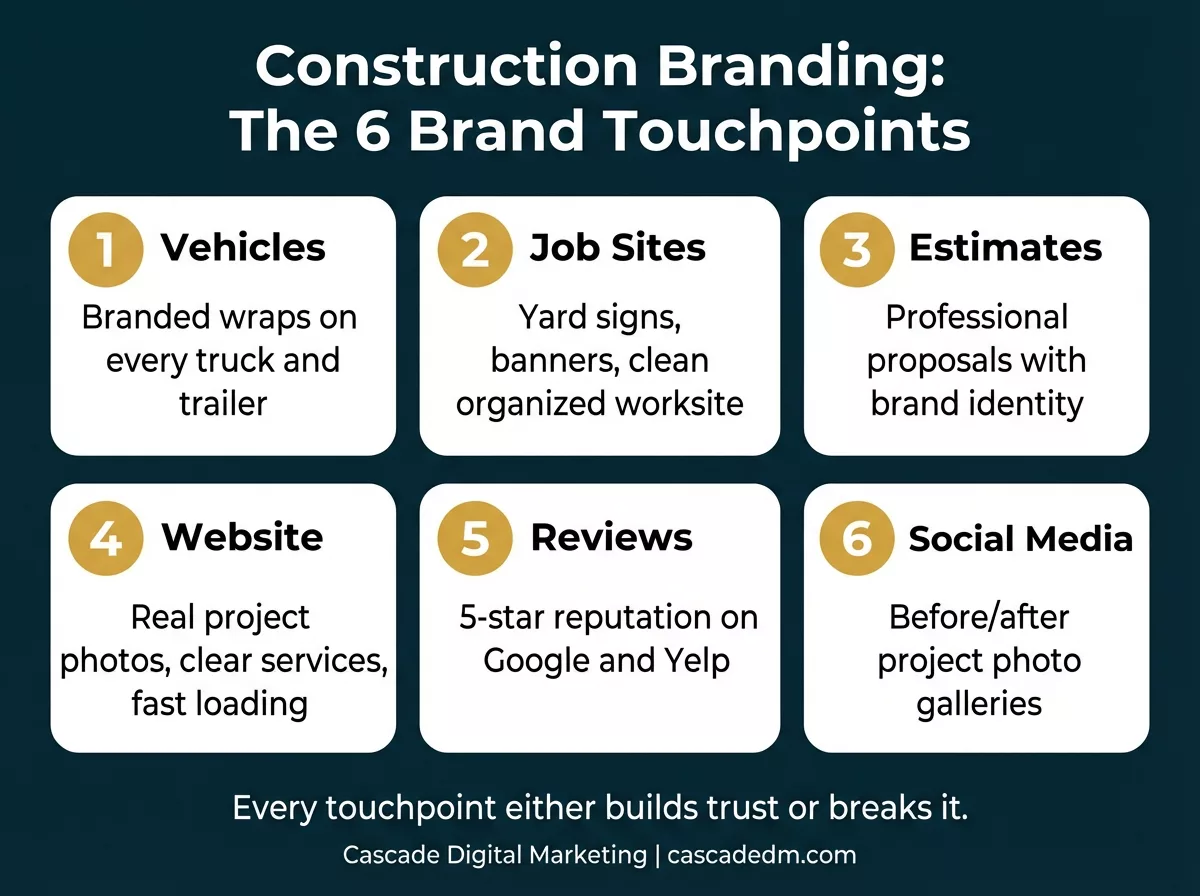
Your brand is the total impression your company creates at every touchpoint. It’s how you show up. All of it, all the time:
-
Your trucks and trailers. Every vehicle on the road is either a moving billboard or a moving blank. A wrapped truck with a clean design, your phone number, and your URL generates impressions all day. An unmarked white van communicates nothing, or worse, that you’re not established enough to invest in your own appearance.
-
Your job site presence. Yard signs, crew uniforms, clean work areas. When your crew shows up in branded shirts and puts a professional sign in the yard, you’re marketing to every neighbor who walks by. Construction projects are public events.
-
Your estimates and proposals. A branded, professional estimate signals that you run a real operation. A handwritten number on a scrap of paper signals the opposite.
-
Your Google Business Profile. This is where most homeowners form their first impression. Your logo, your photos, your review responses. All branding.
-
Your website. I’ll dig into this deeper below, but your website is often the deciding factor between a call and a click to the next company.
-
Your project documentation. Before-and-after photos, project walkthroughs, team content. This is the ongoing story of your brand, not a one-time design exercise.
Every one of these touchpoints either reinforces a consistent identity or sends mixed signals. Sharp logo but outdated website? Mixed signals. Great website but unmarked trucks? Mixed signals. Construction brand identity works when all of these elements tell the same story.
The Trust Problem No One Wants to Talk About
Here’s the uncomfortable reality: homeowners don’t trust contractors.
A 2024 survey by Angi found that 34% of homeowners reported a negative experience with a contractor in the previous two years. Deposits taken and disappeared. Projects 40% over budget. Timelines that doubled. Work that had to be redone by someone else.
This isn’t your fault if you run a legitimate operation. But it is your problem. Every homeowner who’s been burned walks into the hiring process with their guard up. They’re not just evaluating your bid. They’re trying to figure out if you’re the contractor who’s going to ruin their kitchen and ghost them.
Your brand is your first opportunity to address that fear. Before the first phone call. Before the first estimate. Before they ever meet you.
A professional, consistent brand signals:
- Permanence. This is an established company, not a fly-by-night operation. The investment in branding itself communicates stability.
- Accountability. A company that puts its name on trucks, uniforms, and yard signs is a company that stands behind its work. You can’t disappear when your brand is literally driving around town.
- Professionalism. Consistent visual identity signals that you care about details. Homeowners extrapolate: if the company cares about how their proposals look, they probably care about how the tile work looks too.
We saw this play out with GTG Construction, a restoration and remodeling company in the Puget Sound area. When GTG invested in a cohesive brand identity, from their website and ad campaigns down to how their crews presented on job sites, the conversion rate on estimates improved. The brand did the trust-building work before the sales team ever picked up the phone. The result: 5x return on ad spend and a pipeline full of the kinds of projects they actually wanted.
What a Construction Brand Actually Needs
Stop thinking about branding as a creative exercise. Think about it as a system. Here are the components that matter for branding for contractors, in order of impact.
1. A Visual Identity That’s Actually Distinct
Logo, color palette, typography, and a simple set of design rules for how they’re used. The goal is recognition, not awards. When someone sees your truck, your yard sign, and your website, they should instantly know it’s the same company.
What this means in practice:
- Pick colors that aren’t navy blue and orange. I know. Everyone uses them. That’s exactly why you shouldn’t. Look at what your top five local competitors use and choose something different. A construction company with a black-and-gold palette or forest green stands out in a sea of navy.
- Get a logo that works at every size. It needs to be legible on a business card and on a truck wrap. If your logo has fine detail that disappears at small sizes, it’s not functional.
- Choose one or two fonts and use them everywhere. Estimates. Website. Social media. Yard signs. Consistency is the entire point.
2. Branded Vehicles and Job Site Signage
Your trucks are in neighborhoods all day, every day. A professional vehicle wrap costs $2,500 to $5,000 per vehicle and generates 30,000 to 70,000 visual impressions per day, according to the Outdoor Advertising Association of America. There is no marketing channel with a lower cost per impression.
Job site signs serve the same function. A clean yard sign with your company name, phone number, and website tells every neighbor: “This is who’s doing this work, and we’re proud enough to put our name on it.”
3. Professional Estimates and Proposals
Your estimate is a sales document. Treat it like one. A branded PDF with your logo, clear scope of work, itemized pricing, timeline, and terms of service communicates that you run a professional operation. Most home improvement decisions involve two decision-makers, and a professional estimate gives them something tangible to review together.
4. Project Photography
This is the one most contractors skip, and it’s the one with the highest ROI.
Construction companies have a marketing asset that most businesses would kill for: dramatic visual proof of transformation. A before photo of a gutted kitchen next to an after photo of the finished remodel is more persuasive than any copywriting I could produce. It’s undeniable evidence that you do excellent work.
Hire a photographer for your best projects. Budget $300 to $500 per shoot. Or at minimum, train your crew to take consistent photos with a smartphone: same angles before and after, clean job site, natural light when possible.
Use this work everywhere: website, social media, proposals, Google Business Profile, ads. Real project photos outperform stock photography by a factor that isn’t even close. Homeowners can spot a stock photo instantly, and it communicates exactly what you don’t want: “We don’t have real work to show.”
5. Review Management
Reviews are the new word-of-mouth. A construction company with 200 five-star reviews communicates something fundamentally different from one with 12 reviews and a 3.8 rating.
This isn’t passive. You need a system: ask every satisfied client for a review within 48 hours of project completion. Respond to every review, positive and negative, within 48 hours. How you respond to a negative review tells potential clients more about your company than the review itself.
6. A Website That Matches the Quality of Your Work
I’m giving this its own section below because it’s that important.
Your Website Is Your Brand’s Front Door
97% of consumers search online for local businesses before contacting them (BrightLocal). For construction companies, that number is likely higher because the financial stakes of hiring a contractor are significant.
Your website is not a digital business card. It’s your most important sales tool. And right now, a shocking number of construction company websites are actively repelling potential clients.
The contractor with a $200 Wix template featuring stock photos and three paragraphs of text is communicating something very specific: “I didn’t invest in this, and you shouldn’t expect much from me.” Compare that to a professionally designed construction website with real project galleries, clear service descriptions, client testimonials, and a process that shows exactly how you work. The second company gets the call. Every time.
What a construction company website needs to actually function as a brand asset:
- Real project photos. Galleries organized by service line. Not stock photos. Your actual work.
- Service pages with substance. Dedicated pages that describe your process, what the homeowner can expect, and why your approach is different. Not a bulleted list.
- Social proof on every page. Reviews, testimonials, star ratings. Don’t bury them on a testimonials page nobody visits. Put them on every service page and your homepage.
- Clear calls to action. Phone number in the header. Contact form above the fold. Make it easy for someone to take the next step.
- Mobile performance. Over 60% of home service searches happen on phones. If your website requires pinching and zooming, you’re losing leads daily.
- Page speed. Under three seconds. Construction websites are image-heavy, which means compression, lazy loading, and decent hosting matter.
We’ve built construction marketing strategies where the website redesign alone moved the needle on lead quality. Not because the old site was broken, but because the new site communicated a level of professionalism that matched the actual quality of the client’s work.
The Pricing Power of a Strong Brand
Let’s talk about money, because that’s what this is really about.
Branded contractors charge more than unbranded competitors for identical work. Contractors with professional branding and a strong online presence command 15-30% higher prices than competitors with minimal branding in the same market.
Why? Branding reduces perceived risk. When a homeowner is choosing between two bids, one from a company with a clean brand presence, 200 reviews, and a professional website, and one from a company with no website, a Gmail address, and an estimate scribbled on a notepad, the branded company doesn’t need to be the cheapest bid. The homeowner is paying for the confidence that the project will be done right, on time, and by a company that will still exist next year if something goes wrong.
The math: if branding lets you charge 20% more on a $50,000 remodel, that’s $10,000 in additional revenue. On ten projects a year, that’s $100,000. The entire cost of a comprehensive branding investment pays for itself in the first quarter.
GTG Construction experienced this directly. As their brand became more recognizable in the Puget Sound market, they attracted higher-value projects. The brand filtered out price-shoppers and attracted homeowners who wanted the best work. When your brand communicates quality, you stop competing on price and start competing on value.
The Recruitment Advantage Nobody Mentions
Branding doesn’t just attract better clients. It attracts better employees.
The Associated General Contractors of America reports that 94% of contractors had difficulty filling positions in 2025. In a market where every company is competing for the same pool of experienced carpenters and project managers, your brand is a hiring tool.
Skilled tradespeople want to work for companies that look professional and established. They want to show up to a job site in a branded shirt, drive a clean wrapped truck, and work for an operation that takes itself seriously. Not a company whose website looks like it was built by someone’s nephew in 2012.
I’ve heard this directly from construction company owners who rebranded: the quality of job applicants improved. People started reaching out proactively instead of needing to be recruited. A strong brand signals stability and growth. It becomes a magnet for talent, not just clients.
Using Before-and-After Content as Your Secret Weapon
Most businesses struggle to create compelling marketing content. They have to manufacture stories and stage scenarios.
Construction companies have the opposite problem. You create dramatic transformations every single day. A water-damaged living room turned into a showpiece. A dated 1970s kitchen turned into a modern cooking space. The visual story tells itself.
Before-and-after content is the most persuasive format in construction marketing. It’s concrete proof that you do what you say you do. No claims needed. No adjectives required. Just the work, speaking for itself.
Where to deploy before-and-after content:
- Website project galleries. Organize by service line with project details: scope, timeline, and a brief description of the challenge and solution.
- Google Business Profile posts. Weekly before-and-after posts keep your profile active (a ranking signal) and give potential clients a steady stream of proof.
- Social media. Before-and-after carousels are the highest-performing organic content format for construction companies on Instagram and Facebook.
- Estimates and proposals. Include 2-3 relevant before-and-after examples with every estimate.
- Ad campaigns. Before-and-after imagery in paid ads consistently outperforms stock photos and text-only creative.
Make this a system, not an afterthought. Every project gets before photos on day one and after photos on completion day. Assign someone on the crew to own it. The 15 minutes it takes to document each project fuels months of marketing content.
The Damaging Admission: Branding Won’t Fix a Broken Operation
I’d be doing you a disservice if I didn’t say this plainly: a brand is a promise, and broken promises are worse than no promise at all.
If your crews show up late, leave job sites messy, blow past deadlines, and don’t return phone calls, a professional brand identity doesn’t fix that. It makes it worse. Now you’ve set an expectation with your polished website and wrapped trucks, and the actual experience doesn’t match. The homeowner feels deceived.
A bad contractor with great branding is just a bad contractor with a nicer logo. People remember the bad experience more clearly because the branding made the gap between expectation and reality that much more painful.
Before you invest in branding, ask yourself honestly:
- Do our crews show up on time, consistently?
- Do we communicate proactively with homeowners during projects, or do they have to chase us for updates?
- Do we clean up job sites at the end of every day?
- Do we hit our timelines, or do projects routinely run late?
- Do we handle problems quickly when they arise, or do we avoid difficult conversations?
- Would our last ten clients recommend us without hesitation?
If the answer to any of those is no, fix the operation first. Then brand the experience. GTG Construction’s branding worked because the operational reality backed it up. Their crews arrive in uniform. They communicate throughout the project. They do quality work. The brand just made those truths visible to people who hadn’t experienced them yet.
Branding is an amplifier. It amplifies whatever you actually are. Make sure what you actually are is worth amplifying.
Where to Start: A Practical Branding Roadmap
If you recognized your company in the “generic contractor” description, here’s the sequence. The order matters.
Phase 1: Foundation (Weeks 1-4)
- Audit your current brand touchpoints. Google your company name. Visit your website on your phone. Look at your trucks, your estimates, your GBP profile.
- Define what makes your company different. Not “quality craftsmanship.” The real thing. Maybe it’s your all-employee model. Maybe it’s your communication process. Find the truth and build from it.
- Hire a designer for a professional visual identity: logo, color palette, typography, and usage guidelines.
Phase 2: Core Assets (Weeks 5-10)
- Build or redesign your website with real project photos and proper service pages.
- Create branded estimate and proposal templates.
- Update your Google Business Profile with new logo, photos, and consistent information.
- Order vehicle wraps, uniforms, and job site signage.
Phase 3: Content Engine (Weeks 11-16)
- Photograph your 5-10 best recent projects.
- Build project galleries on your website.
- Launch a review generation system.
- Develop a content marketing plan that positions your brand as the authority in your market.
Phase 4: Amplification (Ongoing)
- Run research-driven ad campaigns using your branded assets and real project photography.
- Document every new project for marketing use.
- Update your website quarterly with new projects and fresh content.
The total investment for a comprehensive construction rebrand typically falls between $15,000 and $40,000. That sounds like a lot until you compare it to the revenue impact: higher close rates, premium pricing, better leads, and a compounding brand asset that appreciates every year.
FAQ
How much does construction company branding cost?
A visual identity (logo, colors, typography, guidelines) runs $2,000 to $5,000. A professional website costs $5,000 to $15,000. Vehicle wraps are $2,500 to $5,000 per vehicle. Photography is $300 to $500 per shoot. All-in, a comprehensive brand build ranges from $15,000 to $40,000. The question isn’t whether that’s expensive. It’s whether continuing to look identical to every competitor and competing solely on price costs more. For most companies doing over $500,000 in annual revenue, the branding investment pays for itself within the first year.
Can I build a construction brand myself or do I need to hire someone?
Some components you can handle internally: photo documentation, review management, social media posting, and maintaining brand consistency. The visual identity itself should be done by a professional designer. Same with your website. A DIY logo from an online generator communicates exactly what you’re trying to overcome: that you’re cutting corners. The strategy behind your brand benefits from outside perspective. It’s hard to read the label from inside the bottle. A strategist who understands your market can identify differentiators you’ve been too close to see.
How long does it take for construction branding to show results?
Visual improvements like vehicle wraps and a new website create impact immediately. But the compounding brand effects take 6 to 12 months to materialize. That’s the timeline for recognition to build, for your review profile to grow, and for homeowners to start choosing you based on brand rather than price. The good news: unlike advertising, which stops the moment you stop paying, brand equity accumulates. Year one’s investment makes year two’s marketing more effective.
What’s the difference between branding and marketing for a construction company?
Branding is who you are. Marketing is how you get found. Your brand is your identity: visual look, voice, reputation, client experience. Marketing is the set of activities, including SEO, paid ads, content, and email, that put your brand in front of potential clients. You need both, but branding comes first. Running ads without a strong brand is like turning up the volume on a bad song. More people hear it, but they don’t like what they hear. Build the brand, then amplify it.
Cascade Digital Marketing builds research-driven brands and marketing strategies for construction companies. If your company does great work but your brand doesn’t show it, let’s fix that.